That scenario is exactly why Florida Statute 83.48 matters. Unlike most civil cases in Florida, where each side pays their own legal bills, FS 83.48 is a fee-shifting statute — the losing party can be ordered to pay the winner's attorney's fees. For anyone involved in a Florida residential rental dispute, understanding this law before stepping into a courtroom can mean the difference between a manageable outcome and a financially devastating one.
Key Takeaways
- FS 83.48 allows the prevailing party in a landlord-tenant civil action to recover reasonable attorney's fees and court costs from the losing party.
- A formal judgment or decree is required — voluntary dismissals and settlements without court orders generally don't establish prevailing party status.
- The statute applies equally to landlords and tenants; either side can recover fees.
- Fee awards carry no proportionality requirement — a $3,000 dispute can generate a $15,000 fee judgment against the losing party.
- How your lease is drafted matters: FS 57.105(7) can convert a one-sided fee clause into a mutual obligation, shifting risk to the party that wrote it.
What Is Florida Statute 83.48?
The Statute's Exact Language
Florida Statute 83.48 provides:
"In any civil action brought to enforce the provisions of the rental agreement or this part, the party in whose favor a judgment or decree has been rendered may recover reasonable attorney fees and court costs from the nonprevailing party. The right to attorney fees in this section may not be waived in a lease agreement. However, attorney fees may not be awarded under this section in a claim for personal injury damages based on a breach of duty under s. 83.51."
"This part" refers to Part II of Chapter 83 — Florida's Residential Landlord and Tenant Act, covering sections 83.40 through 83.683. The statute applies to residential tenancies, not commercial leases.
The American Rule Exception
Florida follows the American Rule: each party normally pays their own attorney's fees, regardless of outcome. Fee-shifting requires a specific contractual or statutory basis. FS 83.48 creates that statutory basis in the residential landlord-tenant context, making it a deliberate exception to the default rule.
Two features of the statute shape how courts apply it:
- Fee awards are permissive, not mandatory — the statute says fees "may" be recovered. As the Third DCA confirmed in Nemani v. Sachmechi (2022), a trial court that denies fees to a prevailing party isn't automatically wrong.
- Florida courts strictly construe fee-shifting statutes. Claims must arise from the rental agreement or Part II of Chapter 83 — courts won't extend FS 83.48 to unrelated causes of action.
That strict construction applies equally to both sides. Landlords and tenants stand on equal footing under FS 83.48 — either party can be ordered to pay the other's fees, which is why understanding the statute's scope matters before any dispute reaches a courtroom.
Who Qualifies as the "Prevailing Party"?
The Judgment Requirement
The statute defines the prevailing party as the one "in whose favor a judgment or decree has been rendered." That phrase carries significant weight. A favorable negotiation outcome, a dropped case, or a settlement without court approval generally won't qualify.
The clearest illustration is Ortuzar v. Foley (Fla. 2d DCA, 2022). A landlord filed a residential eviction, the parties attended court-ordered mediation, and the landlord then voluntarily dismissed the case. The tenant immediately moved for attorney's fees as the "prevailing party." The Second DCA reversed the fee award — because no judgment or decree had been entered, there was no prevailing party under FS 83.48.
Mixed Outcomes and Partial Wins
Mixed-outcome cases are less straightforward. Florida courts generally apply the "significant issues" test from Moritz v. Hoyt Enterprises, Inc. (Fla. 1992): the prevailing party is the one who prevailed on the significant issues in the litigation, not necessarily the party who won every individual claim.
For security deposit disputes specifically, FS 83.49(3)(c) has its own fee provision for those disputes. When outcomes are split, courts exercise discretion — and that discretion, confirmed by Nemani, means a partial win won't automatically generate a fee award for either side; courts look at which party prevailed on the claims that actually mattered.
Settlements and Strategic Implications
When a case settles or is dismissed without a court order incorporating the settlement, no prevailing party is typically established under FS 83.48. This creates a fork in strategy:
- A party seeking to avoid a fee award has reason to settle privately, keeping the resolution off the court record.
- A party seeking to preserve fee eligibility should push for a court-entered order rather than a private agreement.
How FS 83.48 Applies in Common Landlord-Tenant Disputes
Eviction Actions
Residential eviction falls squarely within Part II of Chapter 83, so FS 83.48 applies directly. The prevailing party — whether landlord or tenant — can seek fees once a final judgment is entered.
Common procedural defects that can sink a landlord's eviction:
- Miscounting the three-day notice period (weekends and legal holidays must be excluded under FS 83.56)
- Demanding more rent than is actually owed on the notice
- Failing to offer a clear pay-or-vacate option in the notice
- Accepting partial rent after serving the notice
- Defective service of process
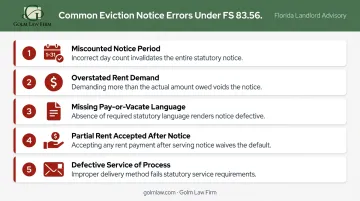
Losing an eviction on procedural grounds can trigger a fee award against the landlord. And unlike a fee award against an insolvent tenant — which may be difficult to collect — a judgment against a landlord can become a real property lien under FS 55.10 when recorded in the county official records, attaching directly to the landlord's property.
Post-2013 law does allow a landlord to cure a defective notice by serving a corrected one and amending the complaint, but only if caught early. Getting the notice right the first time avoids both the cure scramble and the fee exposure that follows a dismissal.
Security Deposit Disputes
The same fee-award exposure arises in security deposit disputes — and these cases under FS 83.49 are high-risk for landlords. The statutory notice requirements are strict: a landlord who intends to impose a claim on a deposit must serve written notice within 30 days after the tenancy ends. The tenant then has 15 days to object.
In Durene v. Alcime (Fla. 3d DCA, 1984), the court held that missing those notice deadlines costs the landlord the right to use the deposit as a setoff — even if the underlying damage claim is valid. A separate damages suit remains available, but the deposit offset is gone.
Documentation landlords should maintain:
- Written move-in and move-out condition reports
- Date-stamped photographs of the property before and after tenancy
- All written communications with the tenant
- Copies of all statutory notices sent, with proof of delivery
Courts look carefully at whether a landlord's deposit claim is well-supported. Weak documentation invites both adverse judgments and fee awards.
How Courts Determine "Reasonable" Attorney's Fees
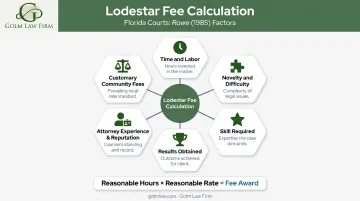
The Lodestar Method
Florida courts calculate attorney's fee awards using the lodestar method, established by the Florida Supreme Court in Florida Patient's Compensation Fund v. Rowe (1985): multiply the reasonable number of hours worked by a reasonable hourly rate.
Factors courts consider in that analysis include:
- Time and labor required
- Novelty and difficulty of the issues
- Skill required to perform the work
- Results obtained
- Experience, reputation, and ability of the attorney
- Customary fees in the community for similar work
No Proportionality to the Dispute Amount
Fee awards under FS 83.48 have no required relationship to the dollar amount in dispute. A tenant who recovers a modest security deposit amount can still have an attorney who spent 10 hours at $300 per hour. If the time was reasonably spent, the court can award the full $3,000 in fees.
The Rowe framework treats "amount involved and results obtained" as one factor among many, not a cap. Fee awards routinely exceed the total amount in dispute.
Procedural Requirements for Fee Motions
The party seeking fees must:
- File a motion within 30 days after the judgment is filed (Florida Rule of Civil Procedure 1.525)
- Support the motion with detailed billing records documenting each task and the time spent
- Provide attorney testimony and often a corroborating fee expert at the hearing
Vague or unsupported fee requests are subject to reduction or outright denial. Courts make specific findings on hours and rate — they don't simply rubber-stamp what the attorney requests.
How Lease Language Interacts With FS 83.48
FS 57.105(7) Makes One-Sided Clauses Reciprocal
Florida leases frequently include their own prevailing party fee clauses. Under FS 57.105(7), if a contract allows attorney's fees to one party when they must take action to enforce it, the court may also allow fees to the other party when that party prevails. In other words, a lease clause written only in the landlord's favor can be wielded by a prevailing tenant.
FS 83.48 goes further: the right to fees under the statute cannot be waived in a lease agreement. Even a lease clause that attempts to eliminate fee-shifting will not hold up in court.
Levy v. Levy and the Drafting Implication
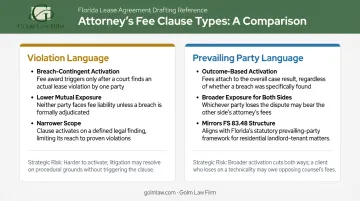
The Florida Supreme Court's 2021 decision in Levy v. Levy (326 So. 3d 678) addressed a fee clause conditioned on a finding of "violation" of an agreement. The Court held that FS 57.105(7) didn't apply because the clause was already bilateral and conditional — it required an actual finding of violation before fees triggered.
The lesson for lease drafting: exact wording matters. Two common clause structures produce very different outcomes:
- "Violation" language — fees only trigger after a court finding of an actual breach
- "Prevailing party" language — fees attach to the outcome of the case, regardless of how it ends
The Ortuzar case reinforced this further — the lease there mirrored FS 83.48's judgment-or-decree language, and the court denied fees under both the statute and the lease when only a voluntary dismissal occurred.
Boilerplate fee clauses often fail at exactly this point — the language looks enforceable until litigation reveals it wasn't drafted with these statutory interactions in mind. Golm Law Firm's residential lease drafting service ($750 flat rate) includes a review of fee provisions to ensure the clause actually performs as intended if a dispute arises.
Practical Strategies to Protect Your Interests
For Landlords
- Serve legally accurate notices — count the days correctly, demand only what's owed, and use the proper form. One clerical error can unravel an otherwise valid eviction.
- Document everything in writing — move-in condition, repairs, communications, and move-out condition. This is your evidence if the case reaches a courtroom.
- Evaluate before filing — because FS 83.48 creates fee-shifting risk in both directions, every landlord-tenant dispute deserves a pre-litigation analysis of whether the likely recovery justifies the potential fee exposure.
- Draft leases carefully — attorney's fee clauses interact with FS 57.105(7) in ways that generic lease templates don't account for.
Golm Law Firm works with Florida landlords on lease drafting, dispute strategy, and landlord-tenant litigation to identify and limit fee exposure before a dispute reaches the courtroom.
For Tenants
FS 83.48 isn't just a landlord's tool. A tenant who prevails in disputes involving wrongful eviction, defective notices, or improperly withheld security deposits can recover their legal costs.
Consulting an attorney early after receiving an eviction notice or discovering a withheld deposit helps a tenant assess whether they have a legitimate claim and what fee recovery might look like.
For Both Sides
The prospect of attorney's fees changes the math on settlement. A case that seems worth fighting over $500 looks different when either side could face a $3,000 fee award at the end. A well-negotiated settlement avoids that unpredictability entirely, preserving resources for both sides without the risk of a court-imposed fee award.
Frequently Asked Questions
What is Section 83.48 of the Florida Statutes?
FS 83.48 is Florida's residential landlord-tenant attorney's fees statute. It entitles the prevailing party in a civil action to enforce a rental agreement or Part II of Chapter 83 to recover reasonable attorney's fees and court costs from the losing party.
Can a landlord make you pay attorney fees?
Yes — if a landlord obtains a judgment in their favor in a landlord-tenant civil action, they can seek attorney's fees from the tenant under FS 83.48. A prevailing tenant holds the same right against the landlord.
Who is the prevailing party under Florida Statute 83.48?
The prevailing party is the one in whose favor a formal judgment or decree is rendered by the court. A voluntary dismissal, a settlement without a court order, or a dropped case generally does not establish prevailing party status under the statute.
What happens to attorney's fees if a landlord-tenant case is settled out of court?
Without a final court judgment, neither side is automatically entitled to fees under FS 83.48. The parties can, however, address attorney's fees directly in their settlement agreement.
Does Florida Statute 83.48 apply to commercial leases?
No. FS 83.48 applies to disputes under Part II of Chapter 83, which governs residential tenancies. Commercial leases fall under Part I of Chapter 83, so attorney's fees in commercial disputes are typically governed by the lease contract's terms or other statutes.
How does a court decide what counts as "reasonable" attorney's fees under FS 83.48?
Florida courts apply the lodestar method: a reasonable hourly rate multiplied by the number of hours reasonably spent. The party seeking fees must file a timely motion supported by detailed billing records, and the court makes specific findings on both the rate and the hours.