The reality is more complicated. Florida law does not require landlords to install or provide air conditioning. But once AC is part of a rental unit, strict obligations kick in—and ignoring them can cost landlords and tenants significantly.
Understanding this distinction is critical whether you're a renter sweating through a Manatee County summer or a landlord trying to stay out of court.
Key Takeaways
- Florida Statute § 83.51 does not list AC as a required amenity—landlords have no statewide duty to install it
- Once AC is provided in a rental, landlords must maintain it; failure to do so can give tenants legal remedies under § 83.56
- Tenants must deliver written notice and allow seven days before pursuing rent withholding or termination
- Lease language on AC maintenance, filter changes, and repair timelines directly determines each party's legal obligations
- Local code enforcement in Manatee County and Bradenton provides a complaint path independent of the lease or court process
Does Florida Law Require Landlords to Provide Air Conditioning?
What Florida Statute § 83.51 Actually Says
Florida Statute § 83.51 requires landlords to comply with applicable building, housing, and health codes, maintain structural components, and provide functioning facilities for heat during winter, running water, and hot water. Air conditioning does not appear on that list.
This surprises many tenants. The absence of AC in a unit is not automatically a habitability violation under Florida's implied warranty of habitable conditions—unlike broken plumbing, structural damage, or no heat in winter.
The Legislative Gap
A 2022 bill (HB 1485) would have required Florida landlords to provide AC in residential rentals. It died in committee. Until the legislature revisits this, no statewide AC installation mandate exists.
Two Exceptions Worth Knowing
Local ordinances can go beyond state law. Some Florida counties and municipalities have housing codes that impose additional landlord duties. Manatee County and Bradenton have not adopted a local AC mandate, but tenants should contact local code enforcement to confirm what applies to their property.
Medical and disability accommodations operate under a separate framework. If a tenant has a documented medical condition requiring cooling, the landlord may have an obligation to provide reasonable accommodation under federal fair housing principles. This analysis is case-specific and requires a documented disability nexus.
When AC Is Provided: Landlord Maintenance Obligations Under Florida Law
The "Once Provided" Rule
If AC was present and functional when the lease was signed—whether central air, a window unit, or a wall unit—it becomes part of the rental agreement. The landlord is legally obligated to maintain it in working order.
The legal basis comes from two sources working together:
- Florida Statute § 83.56 allows tenants to act when a landlord materially fails to comply with § 83.51(1) or a material provision of the rental agreement
- The lease itself — if it lists AC as a provided amenity, that creates a contractual duty to keep it operational
What "Maintain" Means in Practice
Maintenance means timely action — not open-ended delay. In practical terms, it means:
- Repairing or replacing broken units within a reasonable time after receiving proper written notice
- Not shifting repair responsibility to the tenant for normal system failures
- Bringing the system into compliance if local housing codes set cooling standards
Who Pays for What
Not every AC problem is the landlord's bill. The distinction matters:
| Situation | Responsible Party |
|---|---|
| Normal wear-and-tear breakdown | Landlord |
| Compressor failure from age | Landlord |
| Damage from tenant blocking vents | Tenant |
| System failure from unreported issues | Tenant (if failure stemmed from unreported damage) |
| Filter-change neglect causing damage | Tenant (if lease assigns this duty) |
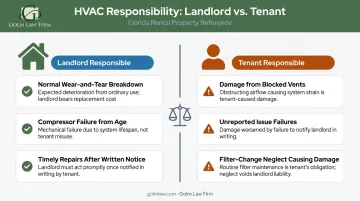
Under Florida Statute § 83.51, landlords are not responsible for conditions created by the tenant's negligent or wrongful acts. Lease language and written documentation — such as move-in inspection reports and maintenance request records — are what determine which side bears the cost when disputes arise.
How Long Can a Landlord Leave You Without AC in Florida?
Florida law does not set a specific number of days for AC repairs. The legal standard is "a reasonable time" after receiving written notice—and what's reasonable gets judged more strictly during peak summer heat.
The Seven-Day Written Notice Requirement
Florida Statute § 83.56 establishes the process:
- Tenant delivers written notice describing the AC problem and stating intent to pursue remedies if not corrected
- Landlord has seven days after receiving that notice to begin meaningful remediation
- If no action is taken within seven days, the tenant may pursue legal remedies including rent withholding or lease termination
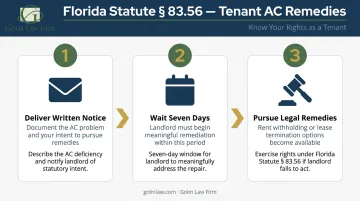
No Florida statute creates a shorter automatic emergency deadline for broken AC, even during extreme heat. When conditions directly threaten health and safety—particularly for children, elderly residents, or those with medical conditions—courts are more likely to treat even a few days without AC as unreasonable.
Documentation Timing Is Everything
When you send your written notice matters as much as what it says. The seven-day clock starts when the landlord receives it, not when you decide to act. A clear paper trail directly affects the timeline of any legal remedy. Document every communication using:
- Certified mail — creates a delivery record with a dated USPS receipt
- Email with read receipt — provides a timestamp and confirmation of receipt
- Date-stamped photos or videos — documents the condition of the unit throughout the repair period
Steps a Florida Tenant Can Take If the Landlord Won't Fix the AC
File a Complaint with Local Code Enforcement
If the landlord ignores the problem, tenants can contact their local code enforcement agency. An inspector will assess the unit and issue a violation notice with a correction deadline.
- Manatee County: Contact Manatee 311 via app, phone, or report online
- City of Bradenton: Call the Code Enforcement Division at 941-932-9485
Code enforcement and rent withholding are separate remedies—a tenant can pursue both simultaneously.
Withhold Rent Under Florida Statute § 83.56
Rent withholding is a legal remedy, but it comes with strict procedural requirements:
- Deliver written notice specifying the AC problem
- Wait seven days for the landlord to act
- If no action, the tenant may deposit withheld rent into the court registry—not simply keep it
Each step matters. A tenant who withholds rent without following the exact statutory procedure loses their legal defense and can be evicted for nonpayment.
Before taking this step, consult a Florida landlord-tenant attorney.
Repair and Deduct: A Complicated Path
Florida Statute § 83.201 is frequently misunderstood. It applies to nonresidential premises—not residential rentals. There is no verified Florida residential repair-and-deduct statute, and no "$5,000 rule" with a verified basis in residential landlord-tenant law.
Bay Area Legal Services confirms that Florida law does not allow residential tenants to make repairs and subtract the cost from rent. Attempting this without legal guidance can create grounds for eviction.
Golm Law Firm represents both landlords and tenants in pre-litigation disputes and can advise on the right steps before any action is taken.
Tenant Responsibilities for AC in Florida
Tenants carry legal duties under Florida Statute § 83.52, including the obligation to use and operate AC facilities in a reasonable manner.
What this means practically:
- Operate the system within normal parameters—don't run it at extremes that damage components
- Report malfunctions to the landlord in writing promptly
- Follow any lease-assigned filter change schedule
- Keep vents and returns unobstructed
Florida state law does not expressly require tenants to change AC filters—that duty comes from the lease, not the statute. But if tenant neglect causes system damage, the landlord can charge repair costs or deduct from the security deposit. A tenant who ignores a dripping coil or skips six months of filter changes and triggers a compressor failure may owe that repair bill.
What Your Lease Agreement Says About AC Matters
When Florida state law is silent on AC, the lease fills the gap. Courts treat lease provisions on AC as enforceable contracts—if AC is listed as a provided amenity, both parties must follow whatever the lease specifies.
Lease Clauses That Matter Most
A well-drafted Florida residential lease should address:
- Filter replacement — who buys them, how often, and what happens if the tenant doesn't comply
- Reporting obligations — how and when tenants must notify the landlord of AC problems
- Tenant-caused damage — what constitutes misuse and what repair costs the tenant bears
- Temporary cooling — whether the landlord can provide portable units while awaiting parts or contractor availability
- Repair timelines — specific response windows that give both parties clear expectations
A lease that simply says "AC included" without addressing maintenance responsibilities leaves both parties exposed. In Florida's climate, AC disputes rank among the most common landlord-tenant conflicts—and most stem from ambiguous lease terms, not the breakdown itself.
Golm Law Firm assists Florida landlords and tenants in drafting and reviewing residential leases, including provisions that define each party's AC obligations before a dispute arises. That upfront clarity is typically far less costly than resolving a conflict after the fact.
Frequently Asked Questions
How long can a landlord leave you without air conditioning in Florida?
Florida law doesn't specify an exact number of days. The standard is "a reasonable time" after written notice. Once seven days pass without action from the landlord, tenants may pursue remedies under Florida Statute § 83.56, including rent withholding through the court registry.
Are landlords responsible for air conditioning in Florida?
Florida landlords are not required to install AC in units that don't have it. But once AC is provided, they are legally responsible for maintaining and repairing it, both under the lease agreement and Florida's habitability requirements.
What is the $5,000 rule for AC in Florida?
No verified $5,000 rule exists in Florida residential landlord-tenant AC law. Florida Statute § 83.201 is a nonresidential statute with no $5,000 threshold. That figure lacks a clear statutory basis in Florida residential rental law.
Can a tenant withhold rent if there is no AC in Florida?
Only after following the strict procedure in Florida Statute § 83.56: written notice, seven-day waiting period, and depositing withheld rent into the court registry. Skipping any step can result in eviction for nonpayment regardless of the AC issue.
Does no AC count as a habitability violation in Florida?
Under § 83.51, AC is not explicitly listed as a habitability requirement. If the landlord provided AC and failed to maintain it, that failure can constitute a breach of the lease—and potentially a habitability violation—depending on the severity of the heat conditions.
What should I do first if my AC breaks and my landlord won't fix it?
Document the issue immediately and send written notice to the landlord with a date stamp—certified mail or email. Keep all communications. If the landlord hasn't responded within seven days of receiving your notice, contact a Florida landlord-tenant attorney before taking any further action.