The core problem runs in two directions. Some buyers and sellers skip legal representation entirely to save money, then face title defects, contract disputes, or post-closing complications that cost far more than an attorney would have. Others walk into closing with no idea what legal fees to expect and get hit with budget surprises.
This article covers exactly what Florida real estate attorneys charge, how fee structures work, what drives costs up or down, who pays, and how to avoid the most common mistakes.
Key Takeaways
- Florida sets no fixed attorney fee — costs vary by transaction type, complexity, and fee structure
- Flat fees for standard residential closings typically run $1,000-$1,500; hourly rates generally fall between $400-$500+
- Who pays attorney fees is negotiable; Florida law doesn't require either party to cover the cost
- Skipping an attorney on a "simple" deal often costs far more than the legal fee when problems emerge after closing
How Much Do Florida Real Estate Attorneys Charge?
Florida does not set a statutory fee for real estate attorney services. There's no official rate schedule — what you pay depends on the type of transaction, the attorney's experience, where in Florida you're located, and how the fee is structured.
That ambiguity leads to real problems: underbudgeting, comparing quotes that cover different scopes of work, or discovering add-on costs at the closing table.
The three main fee structures — flat fee, hourly, and retainer — each work differently depending on your transaction type.
Flat Fee Arrangements
Flat fees apply to well-defined, predictable tasks where the attorney can accurately estimate time upfront. You pay one fixed amount regardless of how long the work takes.
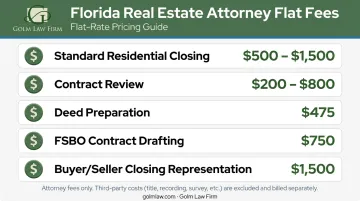
Typical flat-fee ranges for Florida real estate services:
- Standard residential closing: $500–$1,500
- Contract review: $200–$800 depending on complexity
- Deed preparation: attorneys like Golm Law Firm in Manatee County charge $475 for this service
- FSBO contract drafting: $1200 (covering contracts, riders, and disclosure documents)
- Buyer or seller closing representation: $1,500
Flat fees typically cover document review, deed drafting, closing coordination, and title commitment review. They generally don't include title insurance premiums, recording fees, documentary stamp taxes, surveys, or dispute resolution costs. Confirm exactly what's in scope before signing an engagement agreement.
Hourly Rate Arrangements
Hourly billing applies when the scope of work is unpredictable — complex negotiations, multi-party deals, dispute resolution, or commercial transactions with layered due diligence.
According to industry data from Clio, the average Florida real estate attorney hourly rate is approximately $337, with rates for complex or litigated matters reaching $500+ per hour. Urban markets like Miami and Tampa tend to skew higher than mid-size Gulf Coast markets like Bradenton or Sarasota.
Those rates add up fast. Before work begins, ask for a realistic time estimate and clarify what triggers additional billing — an unexpected lender negotiation or title issue can tack on hours you didn't budget for.
Retainer Arrangements
A retainer is an advance deposit — the attorney draws fees from it as work is performed. Retainers commonly run $2,000–$10,000+ depending on the scope of work.
Two important distinctions under Florida Bar rules:
- Advance fee retainer: Held in a client trust account, applied against hourly billing as work is done — unused funds are returned
- True nonrefundable retainer: Earned on receipt and not placed in trust — permissible under Florida Bar Ethics Opinion 93-2 but must be confirmed in writing
Golm Law Firm, for example, requires a $5,000 minimum retainer for litigation matters, billed at $475 per hour against that advance.
Retainer arrangements are most common for investors managing multiple transactions, developers, landlords, and other clients with ongoing legal needs.
Key Factors That Affect Florida Real Estate Attorney Fees
Total legal cost is shaped by a combination of transaction-specific, geographic, and attorney-level variables. Understanding them helps you budget accurately and compare quotes on equal footing.
Transaction Complexity
Complexity is the single largest fee driver. A clean residential resale with no title issues involves a fraction of the work required for a commercial acquisition with zoning review, environmental concerns, or multiple lenders.
Common complexity triggers that push fees higher:
- Foreclosure or short sale properties
- Liens, unrecorded easements, or title defects
- HOA or condo association restrictions and special assessments
- Construction contracts or unpermitted improvements
- Multi-party disputes or boundary disagreements
- Lender-specific due diligence requirements
Attorney Experience and Specialization
Attorneys with deep real estate specialization , particularly those active in the Florida Bar's Real Property, Probate & Trust Law (RPPTL) Section, typically charge higher rates. That premium reflects lower error risk, faster execution, and stronger negotiating ability.
The math often works in your favor: a specialist billing at $400/hour who resolves an issue in two hours costs less than a generalist at $200/hour who takes eight hours and misses something.
Crystal D. Golm of Golm Law Firm is an active RPPTL Section member and affiliate member of the Realtor Association of Sarasota & Manatee Counties — a combination that reflects direct, ongoing involvement in Florida real estate practice.
Geographic Location Within Florida
Legal fees in South Florida metros (Miami-Dade, Broward) and larger markets (Orlando, Tampa) tend to run higher than in mid-size Gulf Coast markets. The Florida Bar's fee reasonableness standard under Rule 4-1.5 explicitly includes "customary fee in the locality" as a factor, meaning geography legitimately influences what attorneys charge.
Bradenton and Manatee County generally offer more competitive rates than the state's largest metros — without sacrificing legal depth.
Additional Closing Costs That Accompany Attorney Fees
Attorney fees are separate from other closing costs clients often bundle into their legal budget:
| Cost Item | Who Sets It | Approximate Range |
|---|---|---|
| Documentary stamp tax (deeds) | Florida statute | $0.70 per $100 of consideration |
| Mortgage doc stamp tax | Florida statute | $0.35 per $100 of loan amount |
| Recording fees | County clerk | $10 first page, $8.50 each additional |
| Owner's title insurance | State-regulated | $5.75 per $1,000 (first $100K) |
| Residential survey | Market rate | $400–$800 typical |
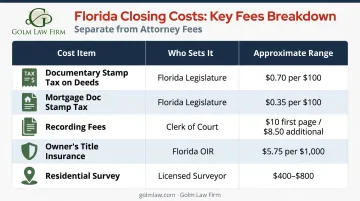
None of these appear on your attorney's invoice — they're third-party or government costs that exist regardless of which attorney you hire.
Residential vs. Commercial Transactions: How Fees Differ
The difference in legal complexity between residential and commercial transactions is substantial, and fees reflect that directly.
Residential Transactions
Residential closings are relatively standardized under Florida law. Most straightforward transactions are handled on a flat-fee basis in the $500–$1,500 range, covering document review, title coordination, and closing attendance. Golm Law Firm charges $1,500 for buyer or seller representation.
Commercial Transactions
Commercial transactions involve a fundamentally different scope of work. Deals involving office buildings, retail centers, apartment complexes, and triple-net leases typically require:
- Zoning and land use review
- Lease analysis and negotiation
- Environmental risk assessment
- Lender-specific documentation requirements
- Complex multi-party contract structuring
Fees are almost always hourly or custom-quoted rather than flat-rate.
For reference, commercial closing representation typically starts at $1,500+, while retainers for complex matters commonly reach $2,000–$10,000+ before hourly billing begins. Golm Law Firm has closed hundreds of millions of dollars in commercial transactions — apartment complexes, office buildings, and shopping centers — which means the firm has navigated the exact due diligence layers and lender requirements these deals demand.
Who Pays Real Estate Attorney Fees in Florida?
Florida law does not mandate which party pays real estate attorney fees. Payment is a **negotiable term in the purchase contract**, and either party can be responsible depending on what's agreed.
Typical conventions:
- Buyers most commonly retain and pay their own attorney for closing representation
- Sellers may pay for deed preparation and title-related services depending on how the contract is written and which party selects the title company
- In Miami-Dade and Broward, the buyer traditionally selects the title company; in most other Florida counties, including Manatee, Hillsborough, and Palm Beach, the seller typically makes that selection
Fee responsibility shifts when a transaction turns contentious. In disputed matters or litigation, Florida courts may award attorney's fees to the prevailing party under F.S. 57.105 when the losing party's claim or defense was unsupported by material facts or existing law. If a dispute seems likely, ask your attorney about fee-award exposure before signing anything.
What Most Buyers and Sellers Get Wrong About Legal Fees
Focusing Only on the Upfront Fee
The lowest-quoted fee is not always the most cost-effective choice. An attorney without specialized real estate knowledge may miss a title defect, an ambiguous contract term, or a compliance issue — problems that surface post-closing and require curative work, title insurance claims, or litigation to resolve. Legal fees for a contested post-closing dispute start at $5,000 in retainers and climb from there at $475/hour or more.
Skipping the Attorney on "Simple" Deals
No deal is as simple as it looks from the outside. A thorough legal review is the only reliable way to catch these problems before closing:
- Unpaid liens attached to the property
- Easement restrictions limiting how land can be used
- HOA violations that transfer to the new owner
- Unpermitted work that fails future inspection
- Undisclosed property defects
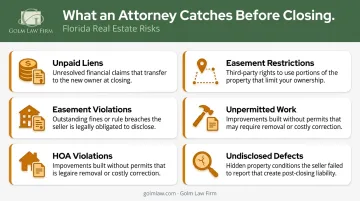
By the time these surface post-closing, you're looking at remediation costs, litigation, or both — not just attorney fees.
Not Asking for a Written Fee Agreement
The Florida Bar requires attorneys to use clear fee agreements, and clients should always request one. A proper engagement letter spells out the fee structure, scope of services, what's excluded, and whether any advance fees are refundable or nonrefundable.
Golm Law Firm uses transparent, fixed pricing — clients receive a written engagement letter before any work begins that details exactly what's covered and what it costs. There are no billing surprises at the closing table.
Conclusion
Florida real estate attorney fees are not one-size-fits-all. They vary based on transaction type (residential vs. commercial), fee structure (flat, hourly, or retainer), attorney experience, and geographic market. Understanding those variables lets you budget accurately and choose representation that fits your specific deal.
Golm Law Firm handles residential and commercial real estate transactions across Manatee County and Florida, with flat-rate pricing on most services so you know your costs before work begins. To discuss your transaction and get a clear picture of fees, schedule a consultation at (941) 704-4049.
Frequently Asked Questions
What are reasonable attorney fees in Florida?
For real estate transactions, flat fees of $500–$1,500 are typical for standard residential closings, while hourly rates of $150–$500+ apply to complex matters. The Florida Bar's Rule 4-1.5 requires all fees to be reasonable — not clearly excessive — based on time, skill, experience, and local customary rates.
What does a $10,000 retainer mean?
A retainer of that size is an advance deposit held in a trust account. The attorney bills against it as work is performed, and any unused portion is typically refunded at the end of the matter.
Who pays attorney fees in real estate?
In Florida, who pays is negotiable between buyer and seller and is addressed in the purchase contract. Conventions vary by county and transaction type. Each party may also independently retain their own attorney, paying separately for their own representation.
Is hiring a real estate attorney required in Florida?
Florida does not legally require buyers or sellers to hire an attorney to close a transaction. Retaining one is strongly advisable, though — title defects, contract errors, and undetected compliance issues can cost far more to resolve than the attorney fee would have.
What is the difference between a flat fee and an hourly rate?
A flat fee is a single predetermined charge for a defined service — such as closing representation — giving you budget certainty. An hourly rate means you're billed for each hour of attorney time, which suits complex or unpredictable matters where the total scope can't be estimated in advance.
How can I avoid unexpected legal fees in a real estate transaction?
Request a written engagement agreement before any work begins. Ask what's included and excluded in the quoted fee, whether any retainer is refundable, and for a realistic time estimate if you're being billed hourly.