The good news: Florida law gives tenants specific, enforceable protections in both situations. But those protections only work if you understand them and act quickly.
This article covers two related but legally distinct scenarios: standard residential eviction under Chapter 83, Part II of the Florida Statutes, and foreclosure-related displacement under Florida's Protecting Tenants at Foreclosure Act (F.S. 83.5615). Knowing which applies to your situation — and what your deadlines are — is the first step.
Key Takeaways
- Florida landlords must provide written notice before filing for eviction — 3 days for non-payment, 7 days for lease violations, 30 days for no-cause month-to-month termination
- A foreclosure does not automatically force you out; bona fide tenants may stay through the end of their lease
- Both Florida law and the federal PTFA require at least 90 days' written notice before a new owner can require you to vacate
- Self-help evictions (changing locks, cutting utilities, removing belongings) are illegal in Florida and can expose a landlord to three months' rent in damages
- Tenants have only five business days to respond to an eviction complaint in court
Florida Eviction Laws: Notices, Timelines, and the Court Process
If your landlord has started eviction proceedings — or you think they might — understanding the process before it escalates is critical. Chapter 83, Part II of the Florida Statutes (the Florida Residential Landlord and Tenant Act) governs all residential evictions statewide, supersedes local regulations, and applies whether or not you have a written lease.
Eviction Notice Types and Required Timelines
Before a landlord can file anything in court, they must deliver proper written notice. Florida Statute §83.56 establishes three primary notice types:
3-Day Notice (Non-Payment of Rent) Triggered by unpaid rent, this notice gives you three days (excluding weekends and legal holidays) to pay the full amount owed or vacate. Pay in full within that window and the landlord cannot proceed with eviction for non-payment.
7-Day Notice (Lease Violation)
- Curable violations (unauthorized pets, parking issues, noise): seven days to fix the problem or face termination
- Non-curable violations (intentional property destruction, repeated violations within 12 months): seven days to vacate, no opportunity to cure
30-Day Notice (No-Cause Termination) For month-to-month tenancies without a specific lease violation, the landlord must provide at least 30 days' written notice before the next rent due date. This requirement was updated by Chapter 2023-314, effective July 1, 2023. Oral notice does not satisfy the statutory requirement: it must be in writing.
Here's a quick reference for all three:
| Notice Type | Trigger | Tenant's Window |
|---|---|---|
| 3-Day Notice | Unpaid rent | Pay in full or vacate within 3 days (no weekends/holidays) |
| 7-Day Notice (Curable) | Lease violation (fixable) | Cure the violation within 7 days |
| 7-Day Notice (Non-Curable) | Serious/repeated violation | Vacate within 7 days, no cure option |
| 30-Day Notice | Month-to-month, no cause | Vacate before next rent due date |
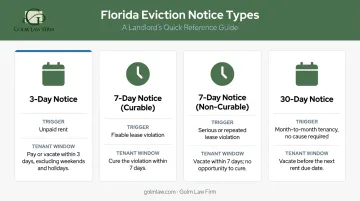
Once proper notice is served and the deadline passes without compliance, the landlord's next step is the courthouse.
Filing, Response, and the Writ of Possession
If you don't comply with the notice, the landlord files an eviction complaint in county court. The timeline moves quickly from there:
- You receive a summons — giving you five business days (excluding weekends and legal holidays) to file a written response under Florida Statute §51.011
- If you don't respond, the court may enter a default judgment and issue a Writ of Possession without a hearing
- The Writ of Possession is posted by the sheriff on your door, giving you 24 hours to vacate — the sheriff, not the landlord, has authority to remove you and your belongings
Critical: The Court Registry Requirement
If you're contesting eviction for non-payment, you must deposit all past-due rent into the court registry when filing your answer — and continue depositing rent as it comes due throughout the case. Under F.S. 83.60(2), failure to do so results in an immediate default judgment against you. Most tenants who lose winnable cases lose them here, not in the courtroom.
Tenant Rights When Your Landlord Is in Foreclosure
Florida is a judicial foreclosure state, meaning lenders must sue in circuit court to foreclose on a mortgage under F.S. 702.01. That process takes time — often many months — which means tenants living in a property under foreclosure have more rights than most realize.
Your Rent Obligation Doesn't Stop
A foreclosure filing against your landlord does not pause your rent obligation. Under F.S. 83.46, rent remains due and payable regardless of what's happening with the mortgage. If you're unsure who the current property owner is after a foreclosure sale, hold your rent in a separate account until you receive official notice from the court or new owner identifying themselves. Don't simply stop paying.
The Core Tenant Protection
Under Florida Statute §83.5615 and the federal Protecting Tenants at Foreclosure Act (PTFA), bona fide tenants with a lease signed before the foreclosure notice have the right to remain in the property through the end of their lease term. The successor in interest takes title subject to your existing lease.
One exception applies: if the purchaser at the foreclosure sale intends to occupy the property as their primary residence, they may terminate your lease early — but they must still give you a minimum 90-day written notice, even if your remaining lease term is longer.
No Lease or Month-to-Month?
Tenants without a written lease, or with a lease terminable at will, are entitled to at least 90 days' notice before being required to vacate — regardless of the new owner's plans.
What to Do When You Receive a Foreclosure Summons
Act immediately. The Bay Area Legal Services foreclosure tenant guide recommends tenants take these steps:
- Notify the court in writing that you occupy the property as a tenant and assert your bona fide tenant status
- Gather your lease, rent payment records, and any written communications with your landlord
- Consult a Florida real estate attorney if you're unsure how to file a notice with the court — missing this step can cost you protections you're legally entitled to
The PTFA and Florida F.S. 83.5615: Understanding Both Layers of Protection
Tenants facing foreclosure-related displacement have two overlapping legal frameworks protecting them.
Federal PTFA
The Protecting Tenants at Foreclosure Act was first enacted in 2009 as part of Public Law 111-22. It was made permanent in 2018 when Section 304 of the Economic Growth, Regulatory Relief, and Consumer Protection Act (P.L. 115-174) repealed the law's sunset provision, with compliance effective June 23, 2018. The FDIC confirms the federal PTFA remains active law.
The PTFA requires successors in interest to honor existing bona fide leases and provide at least 90 days' notice before requiring month-to-month or at-will tenants to vacate.
Florida F.S. 83.5615
Chapter 2020-99, effective July 1, 2020, created Florida's own state-level equivalent — also titled the "Protecting Tenants at Foreclosure Act." It mirrors the federal law and was designed to remain in force as a safeguard if the federal PTFA is ever repealed. Both laws currently apply, and tenants should rely on whichever provides greater protection.
Who Qualifies as a "Bona Fide Tenant"?
Florida Statute §83.5615(3)(a) sets out a three-part test. You must meet all three conditions:
- You are not the mortgagor (the person who took out the mortgage) or an immediate family member (child, spouse, or parent) of the mortgagor
- Your lease resulted from an arm's-length transaction (not a sweetheart arrangement with the borrower)
- Your rent is not substantially below fair market value, unless the reduction is due to a federal, state, or local subsidy
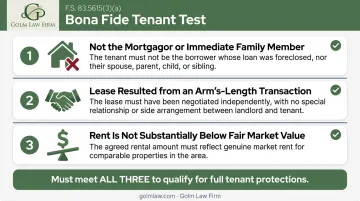
Tenants who don't meet all three criteria do not receive the extended lease-continuation or 90-day notice protections. A properly drafted lease with documented terms serves as direct evidence that all three conditions are satisfied.
Protections Against Illegal Eviction in Florida
Florida law flatly prohibits self-help eviction. Under F.S. 83.67, a landlord cannot:
- Change your locks or use bootlocks
- Remove doors, windows, or roofing
- Shut off utilities — water, electricity, gas, heat, or garbage collection
- Remove your personal property from the premises
These prohibitions apply even if you owe rent. The only lawful path to regaining possession is through a court order and the Writ of Possession process.
Consequences for Landlords Who Violate This
Under F.S. 83.67(6), a landlord who engages in self-help eviction is liable for:
- The greater of three months' rent or your actual damages, plus court costs and attorney's fees
- Immediate injunctive relief to restore access or utilities — a violation constitutes irreparable harm under F.S. 83.67(7), so courts can act quickly
To pursue these remedies, you can file in Small Claims Court for claims up to $8,000, or in County Court for amounts up to $50,000 (as of January 1, 2023, under F.S. 34.01).
Retaliatory Eviction Is Also Prohibited
Under F.S. 83.64, a landlord cannot raise rent, reduce services, or file for eviction because you reported a code violation to a government agency or participated in a tenant organization. If a landlord's action closely follows a protected activity, you can raise retaliatory eviction as a defense in court.
What to Do If You Receive an Eviction Notice or Foreclosure Summons
The most important thing: don't ignore it. The deadlines in Florida eviction and foreclosure law are short and unforgiving.
Step 1: Read the Document Carefully
Identify the type of notice, the deadline for action, and the court where any case is filed. The response window for an eviction complaint is just five business days.
Step 2: Gather Your Documentation
Collect:
- Your lease agreement
- All rent payment receipts or bank records
- Written communications with your landlord
- Photos documenting the property's condition
- Any prior notices received
Step 3: Get Legal Guidance Before the Deadline
The rules around bona fide tenant status, court registry deposits, and responding to foreclosure summons are complex. Getting something wrong — like failing to deposit rent into the court registry while contesting eviction — can result in automatic judgment against you before you even have a chance to be heard.
Golm Law Firm, P.A. in Bradenton advises both landlords and tenants on their rights and obligations under Chapter 83 and F.S. 83.5615. Whether you need help understanding what a notice means, responding to a court filing, or determining whether you qualify as a bona fide tenant, speaking with a licensed Florida attorney before critical deadlines pass can make a real difference.
Golm Law Firm offers 30-minute consultations for $150 and 60-minute consultations with document review for $350. Consultation fees apply toward any subsequent representation.
Frequently Asked Questions
How long before a landlord can evict you in Florida?
The timeline depends on the reason. Non-payment requires a 3-day written notice (excluding weekends and holidays), lease violations require a 7-day notice, and a no-cause month-to-month termination requires 30 days. Only after that notice period expires without compliance can the landlord file a court complaint — adding additional weeks before a Writ of Possession could be issued.
How long do you have to vacate after foreclosure in Florida?
Bona fide tenants may remain until the end of their lease term. However, the new owner must provide at least 90 days' written notice before requiring you to vacate — even if they intend to occupy the home as their primary residence. Tenants without a written lease are also entitled to that same 90-day minimum.
Which law protects tenants from eviction after foreclosure?
Two laws apply: the federal Protecting Tenants at Foreclosure Act (PTFA), active since 2009 and made permanent in 2018, and Florida's own F.S. 83.5615, enacted in 2020 as a state-level complement. Both require 90-day notice minimums and lease-continuation rights for qualifying bona fide tenants.
What is the new law on eviction in Florida?
F.S. 83.5615, effective July 1, 2020, is Florida's most significant recent addition for tenants in foreclosure situations. Chapter 2023-314 also updated month-to-month termination notice requirements to 30 days, effective July 1, 2023. Florida also enacted Miya's Law (effective July 1, 2022), which requires landlords of apartment buildings to conduct background screening for employees with access to individual units.
Can a landlord evict you during a foreclosure in Florida?
Any landlord — or new owner after a foreclosure sale — must still follow the full legal eviction process, including proper written notice and a court order. Bona fide tenants with a valid lease signed before the foreclosure notice have the right to remain through their lease term.
What is a bona fide tenant under Florida foreclosure law?
Under F.S. 83.5615(3)(a), all three of the following conditions must be met:
- You are not the mortgagor or their child, spouse, or parent
- Your lease resulted from an arm's-length transaction
- Your rent is not substantially below fair market value (unless reduced by a government subsidy)
Meeting all three qualifies you for full lease-continuation and 90-day notice protections.