That question sits at the heart of Florida quiet title law. The answer surprises most people: Florida does not impose one bright-line filing deadline for quiet title actions the way it does for personal injury or contract claims. Instead, multiple statutes create overlapping time-based rights and bars — including the 20-year bar under F.S. 95.231(2), the 5-year deed-healing rule under F.S. 95.231(1), and the 7-year deraignment requirement under F.S. 65.061(3).
This guide breaks down each of those rules and explains what they mean for property owners, tax deed buyers, and heirs across Florida.
Key Takeaways
- Florida quiet title actions are governed by Chapter 65, with time-based rules in Chapter 95
- After 20 years from recording, competing claims against a deed holder are permanently barred under F.S. 95.231(2)
- After 5 years, minor execution defects in recorded instruments are cured by operation of law — unless fraud or adverse possession applies
- Plaintiffs must trace their chain of title back at least 7 years before filing under F.S. 65.061(3)
- Tax deed buyers qualify for a simplified pleading path under F.S. 65.081, with no full deraignment of title required
What Is a Quiet Title Action Under Florida Law?
A quiet title action is a civil lawsuit filed in Florida's circuit courts — exercising equity jurisdiction — to establish clear, undisputed legal ownership of real property and remove any competing claims, also called "clouds," from the public record. Chapter 65 of the Florida Statutes is the primary governing authority.
Who Can File
Under F.S. 65.011 and 65.021, the following parties may bring a quiet title action:
- Property owners with defective or disputed title
- Heirs or beneficiaries of an estate with unrecorded title transfers
- Tax deed purchasers whose property still carries old encumbrances
- Foreclosure buyers with lingering junior liens
- Investors with gaps or conflicts in their chain of title
- Multiple persons claiming under a common title source
What a Quiet Title Action Can Accomplish
There are two distinct outcomes a quiet title action can produce:
- Clear a cloud on title by invalidating a defective or competing claim from the property record
- Establish undisputed ownership against all adverse claimants, making the plaintiff the recognized owner of record
Once a final judgment is entered, it may be recorded in the county where the land is located. Under F.S. 65.061(5), that recorded judgment vests title in the same manner as a conveyance executed by a court-appointed special magistrate. This makes it directly useful for anyone planning to sell, refinance, or obtain title insurance on the property.
Understanding what a quiet title action can accomplish is only part of the picture — knowing when you must file is equally important, which is where Florida's statute of limitations rules come in.
Key Florida Statutes That Govern Quiet Title Actions
Florida quiet title actions are governed by four statutes that work in combination — each addressing a different aspect of title disputes, procedural requirements, and time-based limitations.
F.S. 65.061 — The Primary Quiet Title Statute
This statute establishes circuit court jurisdiction over quiet title actions and sets the 7-year deraignment requirement. It covers the following grounds for filing:
- Competing deeds or defective instruments
- Ripened adverse possession claims
- Tax deed title disputes
It also governs the recording and legal effect of the final judgment.
F.S. 95.231(1) — The 5-Year Deed-Healing Rule
After 5 years from the recording of a deed, related power of attorney, or probated will purporting to convey real property, the instrument is treated as conveying fee simple title despite specified execution defects — missing seals, improper acknowledgment, insufficient witnesses. This operates automatically in the absence of fraud, adverse possession, or pending litigation. It is a healing provision, not a filing deadline.
F.S. 95.231(2) — The 20-Year Bar
The 2025 Florida Statutes state : "After 20 years from the recording of a deed or the probate of a will purporting to convey real property, no person shall assert any claim to the property against the claimants under the deed or will or their successors in title."
This is the most powerful time-based protection available to deed holders. Notably, the express exceptions for fraud, adverse possession, and pending litigation appear in subsection (1) — not in subsection (2). That textual distinction matters.
F.S. 65.081 — Tax Deed Quiet Title Actions
When a plaintiff's title derives from a state-issued tax deed, the complaint does not need to trace the chain of title beyond the tax deed itself. This is a significant procedural advantage for tax deed investors — it removes the burden of reconstructing a complete historical chain of ownership.
F.S. 95.11 — Limitations on Accompanying Claims
If a quiet title complaint includes related causes of action, their own deadlines apply:
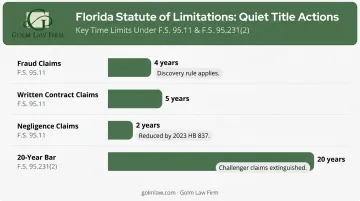
- Fraud claims: 4 years (subject to the discovery rule)
- Written contract claims: 5 years
- Negligence claims: 2 years (reduced from 4 years by CS/CS/HB 837, effective 2023)
What Is the Statute of Limitations for a Florida Quiet Title Action?
Here is the threshold point that surprises most property owners: Florida has no single statute of limitations that applies exclusively to quiet title actions. There is no Chapter 95 provision that says "you must file your quiet title complaint within X years." Instead, time-based constraints operate in two directions — some protect the person filing, others extinguish the ability of challengers to act.
Four distinct provisions govern these constraints — two protecting title holders from stale claims, one a proof requirement, and one a timing risk for challengers.
The 20-Year Bar: The Strongest Protection for Title Holders
For a property owner with a long-recorded deed, F.S. 95.231(2) is the most valuable tool in the quiet title framework. Once 20 years pass from recording, challengers lose their ability to assert competing claims against the deed holder or their successors. This can make a quiet title action easier to win against stale claims, or in some cases unnecessary altogether against challengers whose window has closed.
One important caution: Florida's tolling statute, F.S. 95.051, limits tolling to specific enumerated grounds only. No Florida Supreme Court or DCA decision has squarely held that equitable tolling or the discovery rule defeats this 20-year bar. If a challenger raises tolling arguments, verify whether their grounds appear in F.S. 95.051's enumerated list before assuming the bar applies.
The 5-Year Rule: Healed Deed Defects
If your deed has a technical execution defect and 5 years have passed since recording, the defect is cured by operation of law under F.S. 95.231(1) — meaning you may not need a quiet title action at all.
Covered defects include missing seals, improper witnesses, and acknowledgment problems. Three exceptions override the cure:
- Fraud in the execution or procurement of the deed
- A competing adverse possession claim
- Pending litigation affecting title at the time of recording
Verify none of those apply before assuming the defect is resolved.
The 7-Year Deraignment Requirement: A Proof Rule, Not a Deadline
Under F.S. 65.061(3), a plaintiff must trace their chain of title back at least 7 years before the filing date — or from the original source — unless the court directs otherwise or the parties claim from a common source. This is not a statute of limitations. It is a standing and proof requirement. If your documented chain of title is shorter than 7 years, you will need to assemble additional historical ownership records before your complaint can proceed.
Timing Risk for Challengers
Property owners with competing claims already on record should not wait. Laches can bar relief even before the 20-year window closes — the Third DCA applied laches in a title and boundary dispute in Trevett v. Walker, 113 So. 3d 85 (Fla. 3d DCA 2012), where delay and resulting prejudice were sufficient to defeat the challenger's position. Waiting years to act risks both the evidentiary record and the court's willingness to grant equitable relief.
Common Situations That Require a Quiet Title Action in Florida
Inherited Property and Estate Title Issues
When a Florida property owner dies without a properly recorded title transfer, heirs frequently discover competing claims from other family members, creditors, or holders of unresolved judgment liens. These competing interests can include:
- Unpaid creditor claims or judgment liens recorded against the decedent
- Disputes among heirs over rightful ownership shares
- Missing or defective deeds from prior transfers
A quiet title action under F.S. 65.061 is typically the only mechanism to establish clean, marketable ownership before the property can be sold or refinanced. Without it, title insurance companies will decline to issue a policy.
Tax Deed Purchases and Foreclosure Aftermath
Buyers at Florida county tax deed auctions frequently acquire property that still carries old mortgages, judgment liens, or HOA assessments that the tax deed sale did not extinguish. A quiet title action — using the streamlined pleading rules under F.S. 65.081, which allow the complaint to start at the tax deed rather than trace a full historical chain — is typically required before a title insurer will issue coverage. The Florida Bar Journal has flagged that these title risks have grown more complex in recent years.

Adverse Possession and Long-Vacant Properties
Florida law allows someone who has occupied another party's property long enough to ripen an adverse possession claim — 7 years under F.S. 95.18 without color of title, or under F.S. 95.16 with color of title — to formalize that ownership through a quiet title action. Both the adverse possessor and the record owner hold competing time-sensitive rights. Waiting too long can extinguish a valid claim or expose a record owner to losing title they assumed was secure.
The Quiet Title Process in Florida: Timeline and Key Steps
Step-by-Step Procedure
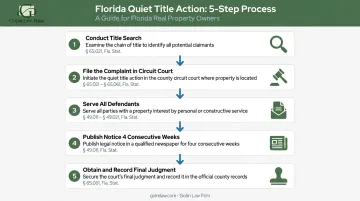
- Conduct a title search — gather all recorded deeds, tax records, judgment liens, mortgages, and other instruments affecting the property; assemble documentation sufficient to satisfy the 7-year deraignment requirement under F.S. 65.061(3)
- File the complaint — in the appropriate Florida circuit court with a full legal description, parcel number, and deraignment of title; tax deed plaintiffs file under F.S. 65.081 with the simplified deraignment starting at the tax deed
- Serve all defendants — named parties must be personally served; for defendants who cannot be located, F.S. 49.011 authorizes service by publication in quiet title matters
- Publish notice — under F.S. 49.10, notice must be published once each week for 4 consecutive weeks when service by publication is required
- Obtain and record the final judgment — once entered, the judgment may be recorded in the county where the land is situated, vesting title per F.S. 65.061(5)
Realistic Timeline Expectations
| Case Type | Estimated Duration |
|---|---|
| Uncontested, no publication needed | 60–90 days |
| Cases requiring publication of notice | Add 4–5 weeks |
| Contested cases with multiple claimants | 6 months to over a year |
We found no official average timeline in public court data for Manatee County or the Twelfth Circuit. These estimates reflect general Florida practice; actual scheduling depends on docket conditions at the time of filing. Contact an attorney familiar with the local circuit for current estimates.
Why Recording the Judgment Matters
Recording the final judgment in the county land records puts the outcome in the public chain of title. Without that recorded judgment, a title insurer typically will not issue a policy — which means the property cannot be conventionally financed or sold to a buyer requiring insurance. If you plan to sell, refinance, or obtain title insurance after the case closes, confirm the judgment was recorded in the correct county before proceeding.
Why Timing and Legal Guidance Matter — and How Golm Law Firm Can Help
Delay in quiet title matters compounds risk in ways that are not always obvious. An adverse claim that sits on record for years can attract additional claimants, generate laches arguments against the true owner, or create complications when a defendant who was unreachable suddenly reappears. The 20-year bar under F.S. 95.231(2) will eventually extinguish old competing claims — but that protection is not guaranteed if fraud, pending litigation, or adverse possession enters the picture before the clock runs.
Property owners in Manatee County and across Southwest Florida who suspect a title problem are better served by acting early than by letting competing claims accumulate on the record.
Golm Law Firm, P.A., based at 1904 Manatee Ave. W. in Bradenton, provides title dispute resolution and quiet title representation to property owners, investors, developers, and heirs throughout the region. Crystal D. Golm, Esq. is a member of the Florida Bar's Real Property, Probate & Trust Law (RPPTL) Section and has facilitated thousands of real estate transactions. That direct experience handling title problems in tax deed sales, estate transfers, and contested ownership situations informs every case the firm takes on.
For property owners who want an initial assessment before committing to full litigation, the firm offers:
- 30-minute consultation ($150) for focused legal questions
- 60-minute consultation with document review ($350) — ideal for situations involving deeds, surveys, or recorded instruments requiring legal analysis
- Pre-litigation limited-scope services starting at $550 for targeted representation prior to filing
- Litigation representation at $475/hour with retainers starting at $5,000 for contested matters
Consultation fees are credited toward the cost of any subsequent flat-fee engagement. Reach the firm at (941) 704-4049, Monday through Friday, 9 AM to 5 PM.
Frequently Asked Questions
What is the quiet title statute in Florida?
Florida quiet title actions are governed by Chapter 65 of the Florida Statutes — primarily F.S. 65.011, 65.021, and 65.061 — giving circuit courts equitable jurisdiction to determine ownership, remove clouds on title, and vest fee simple title. F.S. 65.081 covers tax deed actions specifically, while F.S. 95.231 sets the time-based rules.
What problems can a quiet title action resolve?
A successful quiet title judgment can permanently remove:
- Unresolved liens or mortgages
- Competing ownership claims or deeds
- Title defects from tax deed or foreclosure sales
- Disputed inheritance, boundary encroachments, or chain-of-title gaps
Once recorded, the judgment clears those clouds for title insurance and future transfers.
How long does a quiet title action take in Florida?
Uncontested cases can resolve in 60–90 days; cases requiring publication of notice add roughly 4–5 weeks to that timeline. Contested cases involving multiple claimants or complex title histories can take 6 months to more than a year. Court scheduling in the specific county also affects actual duration.
Can I lose my right to file a quiet title action in Florida?
There is no single filing deadline for quiet title actions, but underlying claims can become time-barred under Chapter 95 — fraud claims carry a 4-year limit, negligence claims carry 2 years. If you hold a recorded deed, others' ability to challenge your title is extinguished after 20 years under F.S. 95.231(2).
What is the 7-year rule in Florida quiet title actions?
Under F.S. 65.061(3), a plaintiff must trace (deraign) their chain of title at least 7 years before the filing date, unless the court directs otherwise or parties claim from a common source. This is a pleading and proof requirement — not a statute of limitations — and it directly affects whether a title insurer will issue a policy on the resulting judgment.