Introduction
Picture this: a heavy storm rolls through Manatee County, and your rental unit's roof starts leaking directly onto your living room floor. Or you wake up to a cockroach infestation that your landlord has ignored for weeks. Florida law gives both tenants and landlords clear rights in these situations.
Florida Statutes §83.51 places clear, enforceable obligations on residential landlords to maintain habitable properties throughout every tenancy. This applies whether you have a written lease or not. Both sides need to understand what the statute actually requires.
This guide covers:
- What Florida's habitability statute requires (and its limits)
- Which conditions legally constitute an uninhabitable unit
- How maintenance obligations differ by property type
- What tenants must do — procedurally — before withholding rent
- What landlords cannot do, even when a tenant stops paying
Key Takeaways:
- Florida's habitability standard comes from §83.51, and no lease clause can waive it
- Tenants must deliver written 7-day notice before withholding rent or terminating a lease
- Air conditioning is not a required habitability feature under Florida law
- Self-help eviction tactics expose landlords to liability of three months' rent or actual damages, whichever is greater
- The court registry rule under §83.60(2) is a critical procedural trap for tenants raising habitability defenses
Florida's Habitability Law: Understanding Florida Statutes §83.51
Florida doesn't use the phrase "warranty of habitability" anywhere in Chapter 83. What it does have is §83.51 — a statute that accomplishes the same thing with practical specificity.
The Core Requirements
Under §83.51(1)(a), landlords must comply with applicable building, housing, and health codes at all times during the tenancy. That language is broad enough to cover most serious conditions a tenant might face.
Where no local code applies, §83.51(1)(b) sets a fallback standard requiring the landlord to maintain:
- Roofs, windows, doors, floors, steps, porches, exterior walls, and foundations in good repair
- All structural components capable of resisting normal forces and loads
- Plumbing in reasonable working condition
- Screens installed in reasonable condition at the start of the tenancy
The obligation is continuous — not just at move-in.
The Implied Nature of the Obligation
This duty exists even if the lease says nothing about it. More importantly, under §83.47, any lease provision that attempts to waive or eliminate these rights is void and unenforceable. A landlord cannot contract their way out of §83.51.
The Air Conditioning Misconception
Many Florida tenants assume that because the state's climate is brutal, landlords are legally required to provide air conditioning. That assumption is wrong — and a costly one to misread.
Air conditioning does not appear in §83.51's list of required structural or utility components. It appears in §83.52 — the tenant obligations section — which instructs tenants to use existing AC systems reasonably if they're already present. A broken AC unit is not a statutory habitability violation. It may, however, be a contractual breach if your lease specifically guarantees AC as an amenity.
When Landlords Are Off the Hook
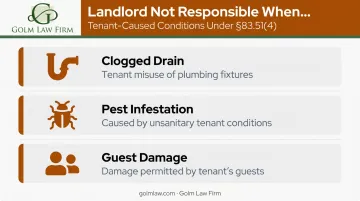
§83.51(4) carves out one significant exception: landlords are not responsible for conditions created by the tenant, a family member, or anyone on the premises with the tenant's consent.
Common examples that fall squarely on the tenant include:
- A clogged drain caused by tenant misuse or neglect
- A pest infestation linked to unsanitary living conditions
- Property damage caused by a guest the tenant permitted on the premises
What Conditions Make a Florida Rental Property Legally Uninhabitable
Structural and Safety Hazards
The clearest habitability violations involve physical failures that compromise safety:
- A roof that actively leaks after rain
- Floors or walls that are structurally unsound
- Windows or doors that fail to keep out weather or provide basic security
- Stairs, porches, or railings that present fall hazards
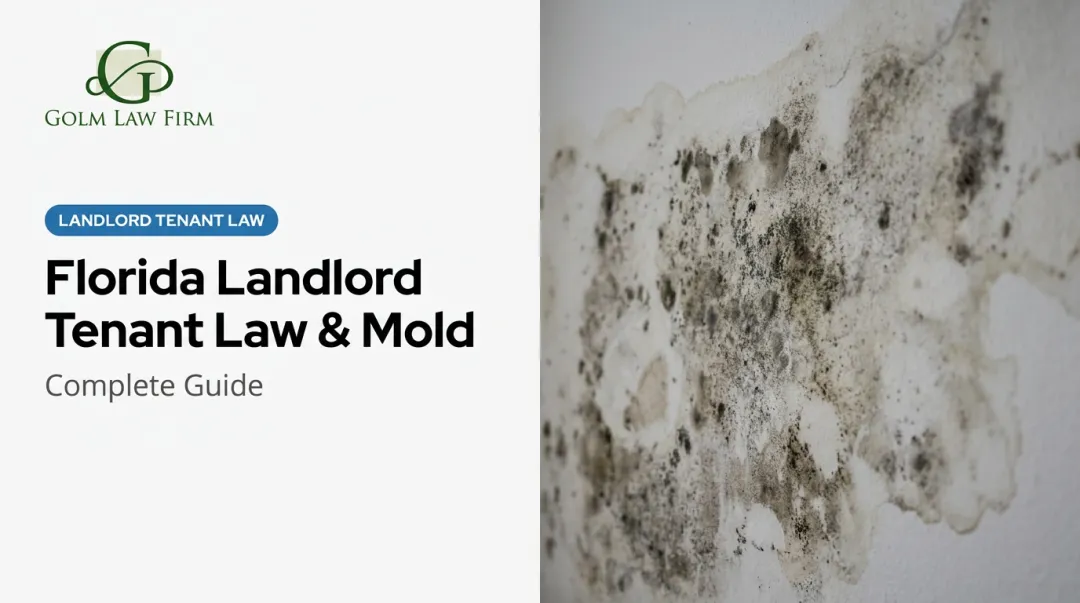
Chemical and biological hazards fall under the same umbrella. Toxic mold — particularly relevant in Florida's humid climate — can render a unit uninhabitable when it results from water intrusion the landlord failed to address. The Florida Department of Health notes that mold grows wherever moisture is present, and that fixing the moisture source is an essential part of any remediation. Lead and asbestos in older rental stock raise similar concerns.
Essential Utilities and Systems
A habitable unit must have:
- Hot and cold running water via functioning plumbing
- A working flush toilet
- Electrical systems maintained in a safe condition
- Working heating facilities
Air conditioning is absent from this list by design. Heating must function; cooling does not carry the same statutory obligation.
Pest and Rodent Infestation
Under §83.51(2)(a), landlords of multi-family units must make reasonable provisions for extermination of rats, mice, roaches, ants, wood-destroying organisms, and bedbugs. An active infestation that a landlord ignores can cross into uninhabitable territory.
If a tenant must vacate during extermination, the landlord must:
- Provide 7 days' written notice before the tenant must vacate
- Abate rent for the displacement period
- Limit the required vacancy to no more than 4 days
The landlord is not liable for damages during the extermination period, but the rent abatement obligation is firm.
Landlord Maintenance Obligations: How Property Type Affects Your Duties
Florida's maintenance statute doesn't treat all rental properties the same way. The property type determines which obligations apply and which can be shifted to tenants by written agreement.
Multi-Family Units vs. Single-Family Homes and Duplexes
§83.51(2)(a) imposes additional obligations on landlords of multi-family units (any residential property that is not a single-family home or duplex), including:
- Pest extermination
- Functional locks and keys
- Clean and safe common areas
- Garbage removal and outside receptacles
- Working heating, hot water, and running water
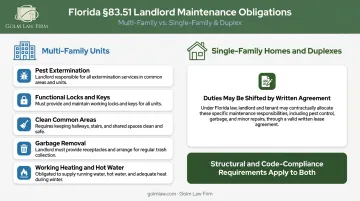
For single-family homes and duplexes, these additional obligations can be shifted to the tenant by written agreement. However, that written agreement cannot eliminate the baseline structural and code-compliance requirements of §83.51(1). Those apply regardless of what the lease says.
This distinction matters most at the lease drafting stage. A residential lease for a single-family home can lawfully shift many maintenance responsibilities to the tenant, but only in writing and only within the limits the statute allows. A standard template rarely addresses these allocations with the precision Florida law requires — which is where a properly drafted lease earns its value. Golm Law Firm drafts residential leases at a flat rate of $750.
Smoke Detectors and Screen Maintenance
Two specific rules apply to single-family homes and duplexes that are worth knowing separately:
- Smoke detectors: The landlord must install working smoke detection devices at the start of the tenancy, unless the parties agree otherwise in writing. For other residential structures, local building and housing codes control.
- Screen maintenance: At the start of the tenancy, screens must be in reasonable condition. After that, the landlord is obligated to repair screen damage once per year when necessary, until the rental agreement ends.
The screen rule applies regardless of property type.
Common Areas in Multi-Family Properties
In multi-unit buildings, landlords are responsible for keeping common areas — hallways, stairwells, entryways, parking areas, laundry rooms — in a clean, safe, and structurally sound condition. Failure to maintain common areas can support a habitability claim even if the individual unit itself is in good condition.
What Tenants Can Do When a Landlord Fails to Maintain Habitability
Florida law gives tenants real remedies — but the process is procedurally strict. Skipping steps can eliminate those remedies entirely.
Step 1: Written 7-Day Notice (Non-Negotiable)
Before a tenant can withhold rent or terminate the lease for habitability reasons, they must first deliver written notice to the landlord that:
- Identifies the specific habitability failure
- States the tenant's intent to either withhold rent or terminate the rental agreement
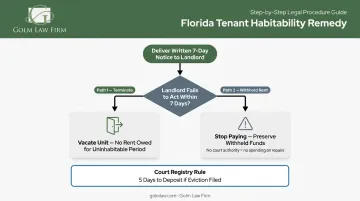
Under §83.56(1) and §83.60(1)(b), the landlord then has 7 days to remedy the problem. Nothing can happen legally until that notice period expires without action.
Step 2: Two Options After the Notice Period
If the landlord fails to act within 7 days, the tenant has two paths:
- Terminate the lease — if the failure renders the unit untenantable and the tenant vacates, they owe no rent for the uninhabitable period
- Withhold rent — the tenant may stop paying, but the withheld funds must be preserved; there is no statutory right to spend withheld rent on repairs before obtaining court authorization
The Court Registry Trap
This is where many tenants lose otherwise valid habitability defenses. Under §83.60(2), if a landlord files for eviction and the tenant raises any defense other than payment, the tenant must deposit all accrued rent into the court registry. The deadline is 5 days from service (excluding weekends and legal holidays).
Miss that deadline? The statute calls it an "absolute waiver" of all defenses, and the landlord is entitled to an immediate default judgment and writ of possession — no further hearing required.
That 5-day window is unforgiving. For tenants or landlords dealing with an escalating habitability dispute, speaking with a Florida real estate attorney before the eviction filing lands can prevent an otherwise strong defense from disappearing on a procedural technicality. Golm Law Firm offers consultations starting at $150 for a 30-minute session, or $350 for a 60-minute session with document review, and either fee applies toward any retained service.
Prohibited Landlord Actions: Self-Help Evictions and Retaliation
Self-Help Is Illegal — and Expensive
Even when a tenant has stopped paying rent, Florida law prohibits landlords from taking matters into their own hands. Under §83.67, a landlord cannot:
- Cut off utilities (water, electricity, gas, heat, garbage collection, refrigeration)
- Change locks or use any device to prevent access
- Remove doors, windows, or the roof
- Remove the tenant's personal property from the unit
A landlord who does any of these things faces liability for actual and consequential damages, or three months' rent — whichever is greater — plus attorney's fees and costs.
Retaliation Is Also Prohibited
Under §83.64, landlords cannot raise rent, cut services, or threaten eviction in response to a tenant who:
- Complained to a government code enforcement agency
- Organized or joined a tenant association
- Exercised any legal right under the Florida Residential Landlord Tenant Act
Tenants can raise retaliatory conduct as a defense in any eviction action. A landlord can overcome it by demonstrating good cause — such as nonpayment or a documented lease violation — but once the defense is raised, the landlord bears the burden of proving the action was legitimate.
The Only Lawful Removal Process
Winning in court doesn't give a landlord the right to physically remove a tenant. The process must follow a specific sequence:
- The court issues a writ of possession after judgment
- The sheriff's office — not the landlord — posts 24 hours' notice at the property
- After that 24-hour period, the landlord or their agent may change locks and move personal property, but only with the sheriff present
Any landlord who skips these steps and removes a tenant directly — even after a court victory — still faces liability under §83.67.
When a Landlord Is Not Legally Responsible for Repairs
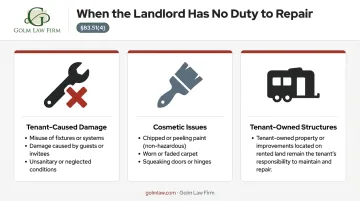
Not every complaint a tenant raises triggers a landlord's repair obligation. Florida law carves out three clear categories where landlords bear no duty to repair:
- Tenant-caused damage — Under §83.51(4), problems created by the tenant, a household member, or a guest fall outside the landlord's statutory duty. Plumbing damaged by misuse, pest issues tied to unsanitary habits, or broken fixtures a tenant caused are all the tenant's problem to resolve.
- Cosmetic issues — Chipped paint, worn carpet, and squeaking doors are frustrating, but Florida's habitability statute focuses on code compliance, structural integrity, plumbing, and specific utility obligations. A minor inconvenience that doesn't threaten safety or render the unit genuinely unlivable doesn't meet the legal threshold.
- Tenant-owned structures — Landlords have no habitability obligation for structures the tenant owns on the property. A tenant-owned mobile home on a rented lot, for example, is entirely the tenant's responsibility.
The line between a landlord's duty and a tenant's responsibility isn't always obvious — and misreading it can have real legal consequences for either side.
Frequently Asked Questions
What is the habitability law in Florida?
Florida Statutes §83.51 governs residential landlord maintenance obligations, requiring landlords to comply with applicable building, housing, and health codes throughout the tenancy. Where no local code applies, landlords must maintain structural components and plumbing in good repair. This obligation cannot be waived by lease.
How long does a landlord have to fix habitability issues in Florida?
After a tenant delivers written notice identifying the specific problem, the landlord has 7 days to remedy it before the tenant may legally withhold rent or terminate the lease. Note that AC is not a statutory habitability requirement — but mold from water intrusion typically is.
What qualifies as landlord negligence in Florida?
In the habitability context, landlord negligence includes failing to maintain required structural components, allowing active pest infestations to persist after notice, and ignoring broken plumbing or unsafe electrical systems. Failing to act within the 7-day notice period after receiving proper written notice from the tenant also qualifies.
Can a tenant withhold rent for an uninhabitable property in Florida?
Yes — but only after delivering written 7-day notice to the landlord. If the issue goes unresolved, rent may be withheld provided the funds are preserved. Should the landlord file for eviction, withheld rent must be deposited into the court registry within 5 days or the tenant forfeits all defenses.
Can a landlord be sued for an uninhabitable property in Florida?
A landlord who fails to maintain habitability can face liability for resulting damages. Under §83.48, the prevailing party in a civil enforcement action may also recover reasonable attorney's fees and court costs — which is why understanding your legal position early can significantly affect the outcome.
Does a landlord have to provide air conditioning in Florida?
No. Under Florida Statutes §83.51, air conditioning is not a required habitability feature. However, if the lease specifically provides AC as an amenity, a broken system may constitute a contractual breach — separate from a statutory habitability violation — and the tenant may have remedies under the lease terms.