This gray area trips up Florida landlords every year. Many withhold funds for routine aging, miss statutory deadlines, or charge full replacement costs on items that have already lived most of their useful life. Any of those mistakes can forfeit your right to make deductions at all.
Florida's Chapter 83 provides a clear framework for what counts as normal wear and tear versus deductible damage. This guide covers the legal definition, concrete examples by category, how tenancy length factors in, security deposit rules, documentation requirements, and the most common mistakes to avoid.
Key Takeaways
- Florida law lets landlords deduct only for damage beyond normal wear and tear — not routine aging
- Florida Statute §83.49 requires written notice of deductions within 30 days of move-out — miss that deadline and you forfeit all claims, regardless of the damage
- Without documented move-in condition evidence, courts presume deterioration is normal wear and tear
- Landlords must prorate replacement costs based on remaining useful life, not charge full price
- Security deposit disputes are among the most litigated landlord-tenant issues in Florida — proper documentation is your best defense
How Florida Law Defines Normal Wear and Tear
Florida Statutes do not contain a single explicit definition of "normal wear and tear." What they do provide — consistently throughout Chapter 83 — is a legal standard that courts apply to every security deposit dispute.
The Statutory Framework
Florida Statute §83.49 governs security deposit procedures and establishes that landlords may only claim funds for damage beyond normal wear and tear. This threshold appears again in §83.491, which covers fee-in-lieu-of-deposit arrangements — stating that landlord insurer claims may include repair costs for damage "beyond normal wear and tear," along with an itemized list and supporting documentation. The phrase isn't buried in one statute. It runs throughout Florida landlord-tenant law.
The Florida Bar's public guidance reinforces this standard directly: tenants must maintain the dwelling "without damage, other than ordinary wear and tear," and return it with "no damage beyond ordinary wear and tear."
What This Means in Practice
Florida courts consistently interpret normal wear and tear as the natural, gradual deterioration resulting from ordinary residential use — not negligence, misuse, or accidents. The question courts ask isn't whether something changed during the tenancy. It's whether that level of deterioration was reasonable given:
- The type of property and its age
- The length of the tenancy
- How the space was actually used
The burden of proof falls on the landlord. Florida's framework does not automatically favor tenants, but it does require landlords to demonstrate that claimed damage exceeds the normal wear and tear threshold. Without documented baseline evidence from move-in, courts will presume that any deterioration found at move-out falls within the protected standard.
Normal Wear and Tear vs. Damage: Side-by-Side Examples
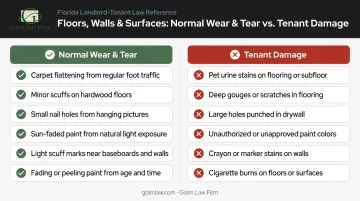
Wear and tear is the cost of doing business as a landlord. Damage results from tenant negligence, accidents, or misuse, and only the latter supports a security deposit deduction under Florida law.
Floors and Carpets
| Normal Wear and Tear | Tenant Damage |
|---|---|
| Carpet flattened in hallways from foot traffic | Large pet urine stains throughout carpet |
| Minor scuffs on hardwood from furniture placement | Deep gouges from dragging heavy objects without protection |
| Slight fraying near thresholds | Cigarette burns in carpet |
| Carpet faded or worn thin from walking | Holes, stains, or burns requiring full replacement prematurely |
Walls and Paint
| Normal Wear and Tear | Tenant Damage |
|---|---|
| Small nail holes from picture hanging | Large holes punched through drywall |
| Light scuff marks from furniture near walls | Unauthorized paint in bold or dark colors |
| Fading paint near windows from sun exposure | Crayon, marker, or paint stains |
| Fading, peeling, or small chips from aging | Seriously damaged or torn wallpaper |
Fixtures, Appliances, and Other Surfaces
Normal wear includes:
- Loose cabinet hinges from regular opening and closing
- Faded appliance dials from routine use
- Light grout discoloration over time
- Peeling caulk around tubs from age and moisture
Deductible damage includes:
- Broken appliances caused by misuse (not mechanical failure)
- Clogged drains from tenant neglect (grease buildup, foreign objects)
- Missing fixtures or hardware
- Smoke discoloration on walls and ceilings in a non-smoking unit
- Chipped or broken sink and tub enamel from impact damage
These HUD wear and tear guidelines reflect how Florida courts evaluate residential property condition.
How Tenancy Length and Useful Life Affect What You Can Charge
Florida courts factor in how long a tenant occupied the property. Deterioration that might be considered damage after six months could be entirely expected — and legally protected — after three to five years.
Expected Deterioration by Year
- After 1 year: Light scuffs, a few nail holes, minor carpet matting
- After 2–3 years: Noticeable paint fading, deeper carpet wear in traffic areas
- After 5+ years: A full repaint and carpet replacement are typically expected landlord expenses — not tenant liabilities
The Useful Life Principle
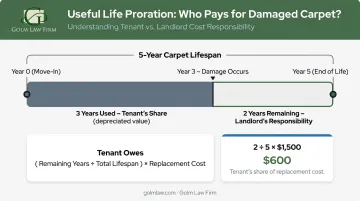
Florida courts apply a "useful life" framework when calculating deductions. You cannot charge a tenant the full replacement cost of an item that has already reached or is near the end of its expected lifespan.
HUD's life expectancy benchmarks provide a consistent reference point courts rely on:
- Plush carpet: 5 years (family units)
- Interior paint (flat): 3 years (family units)
- Interior paint (enamel): 5 years (family units)
Proration is straightforward in practice. If a carpet with a 5-year life expectancy is destroyed after 3 years, the tenant owes only 2/5 of the replacement cost (the remaining 2 years of useful value). Charging full replacement cost on a 4-year-old carpet in a 5-year tenancy is a deduction Florida courts will disallow.
Florida Security Deposit Rules: What You Can and Cannot Deduct
The §83.49 Framework
Under Florida Statute §83.49, landlords must:
- Hold deposits in a separate, non-commingled account (or post a surety bond)
- Return the deposit within 15 days of move-out if making no deductions
- Send written notice within 30 days of move-out if intending to make deductions, stating the reason and amount
The statutory notice language: "This is a notice of my intention to impose a claim for damages in the amount of ____ upon your security deposit, due to __."
What You Cannot Deduct
- Routine cleaning needed to restore normal cleanliness
- Repainting necessitated by ordinary aging and fading
- Carpet replacement due to expected wear over a full tenancy
- Any deterioration that falls within the normal wear and tear standard
What You Can Deduct
- Repairs for tenant negligence or misuse (holes in walls, broken fixtures, pet damage)
- Smoke damage in a non-smoking unit
- Stains beyond normal use
- Costs from unauthorized alterations
- Unpaid rent
Consequences for Getting It Wrong
If a landlord fails to send written notice within 30 days, the right to impose any claim on the deposit is forfeited — regardless of how legitimate the damage is. The landlord may still file a separate action for damages, but cannot withhold from the deposit.
If either party sues over a security deposit, the **prevailing party is entitled to court costs and reasonable attorney fees** under Chapter 83. That fee-shifting provision means a landlord who loses a dispute over a $400 cleaning charge can end up paying thousands in opposing counsel fees.
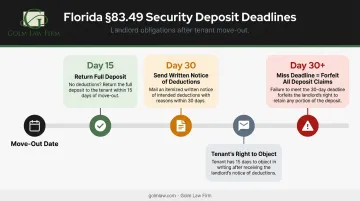
The 15-day objection window: That exposure becomes real quickly. After receiving the landlord's notice, a tenant has 15 days to object in writing. If the dispute escalates to small claims court, your documentation — not your intentions — determines whether the deduction holds up.
How to Document Wear and Tear as a Florida Landlord
Documentation is the landlord's primary legal protection. Without a documented baseline showing the property's condition at move-in, courts will presume that any deterioration found at move-out is normal wear and tear.
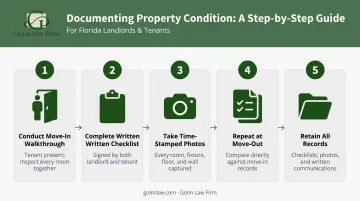
A Practical Documentation Process
- Conduct a move-in walkthrough with the tenant present — room by room, surface by surface
- Use a written condition checklist — signed by both landlord and tenant at move-in
- Take time-stamped, high-resolution photos of every room, fixture, wall, and floor
- Repeat the same process at move-out — compare conditions directly against move-in records
- Keep all records — signed checklists, photos, and any written communications
Mid-Tenancy Inspections
Florida Statute §83.53 gives landlords the right to enter a rental property with at least 24 hours' written notice during reasonable hours (7:30 a.m. to 8:00 p.m.) for inspections and repairs. Semi-annual walkthroughs serve two purposes: catching developing damage early, and creating a mid-tenancy documentation trail that gives you documented evidence to counter disputed deductions at move-out.
Lease Language That Protects You
Your documentation process is only as strong as the lease behind it. A well-structured lease eliminates ambiguity before disputes arise by spelling out exactly what's expected. Key provisions to include:
- Tenant responsibilities for routine maintenance and cleanliness
- Defined standards for acceptable wear versus tenant-caused damage
- The move-in and move-out condition documentation process
- Notice requirements for repairs and inspections
Golm Law Firm drafts residential leases for Florida landlords at a flat rate of $750. Working with a Florida real estate attorney to build these protections into your lease costs far less than defending a misclassified deposit claim in court.
Common Mistakes Florida Landlords Make with Security Deposits
Deducting for Normal Aging Without Documentation
The most common mistake: withholding funds for faded paint, worn carpet, or deteriorated fixtures without a signed move-in checklist or photos. Florida courts will routinely side with the tenant when no baseline condition evidence exists.
Missing the 30-Day Notice Deadline
Florida law is unambiguous. Miss the 30-day window and you forfeit the right to make any deductions — even if the damage is real, documented, and clearly beyond normal wear. This deadline is not flexible.
Charging Full Replacement Cost Instead of Prorated Value
Florida courts expect landlords to deduct only the depreciated cost based on remaining useful life. Charging $1,500 for full carpet replacement on carpet that was already four years into a five-year lifespan will not survive a legal challenge. Courts tend to view inflated claims as a signal that the landlord's entire case lacks merit.
Frequently Asked Questions
What is normal wear and tear after 5 years in Florida?
After five years, most flooring, paint, and fixtures are expected to show significant aging — carpet likely needs replacement, walls require a full repaint, and appliance finishes may be faded. Florida courts will generally classify all of this as normal wear and tear that cannot be charged to the tenant.
What can a landlord deduct from a security deposit in Florida?
Under Florida Statute §83.49, landlords can deduct for damages beyond normal wear and tear (holes in walls, pet damage, broken fixtures, smoke staining), unpaid rent, and costs from lease violations. Routine aging, expected maintenance, and standard cleaning are not deductible.
What is the 83.53 law in Florida?
Florida Statute §83.53 governs landlord entry rights, requiring at least 24 hours' written notice before entering a rental unit except in emergencies. Landlords can use scheduled inspections under this statute to document property condition and identify damage before move-out.
Can a Florida landlord charge a tenant for carpet replacement?
Only for damage beyond normal wear — stains, burns, or pet damage. The charge must be prorated based on the carpet's remaining useful life. If the carpet was already near the end of its expected lifespan, little to nothing can be charged to the tenant.
How long does a Florida landlord have to return a security deposit?
If making no deductions, the deposit must be returned within 15 days of move-out. If deductions are intended, written notice must be sent within 30 days. Missing either deadline can result in forfeiting the right to any deductions.
Does Florida law require a move-in checklist for security deposit deductions?
Florida law does not mandate a specific checklist form, but courts consistently rule that without documented move-in condition evidence, any deterioration found at move-out is presumed to be normal wear and tear. A signed, photo-supported checklist is the most reliable protection a landlord has when contesting deposit disputes.