Introduction
Florida's climate creates near-perfect conditions for mold. The Florida Climate Center confirms Florida is the most humid state in the country, with summer dew points regularly hitting 65–75°F and nighttime relative humidity exceeding 90%. Add an average of 85 thunderstorms per year and decades of aging rental housing stock, and mold disputes become almost inevitable.
Despite how common mold problems are, Florida has no dedicated mold statute. Landlords and tenants must navigate general habitability laws, licensing requirements, and procedural rules instead. A misstep by either party can be costly.
This guide covers the full legal picture: what Florida statutes actually require, what landlords must do, what rights tenants hold, and the specific steps both sides should take when a mold dispute arises.
Key Takeaways
- Florida's implied warranty of habitability under Fla. Stat. § 83.51 obligates landlords to address mold caused by structural failures or maintenance neglect
- Tenants must send a written 7-day notice before withholding rent or terminating a lease
- Mold work exceeding 10 square feet requires a DBPR-licensed assessor and remediator under Fla. Stat. § 468.8411
- Documentation—photos, written notices, medical records, receipts—determines outcomes in disputes
- Tenants have multiple legal remedies available—rent withholding, lease termination, and civil suits—but each one comes with specific procedural steps that must be followed
Florida Mold Law: What the Statutes Actually Say
No Dedicated Mold Statute, But Legal Protections Still Exist
Many tenants and landlords are surprised to learn that neither federal law nor Florida's Chapter 83 contains a statute specifically governing mold in rental properties. There is no mold disclosure requirement comparable to California's, which mandates written disclosure when a landlord knows qualifying mold is present.
Meaningful legal protections do exist — they just come from general habitability law rather than mold-specific rules.
Fla. Stat. § 83.51 requires landlords to maintain rental units in compliance with applicable building, housing, and health codes. Where no specific codes apply, landlords must keep roofs, windows, doors, floors, exterior walls, foundations, and plumbing in good repair throughout the tenancy. Courts have interpreted these structural maintenance duties to cover mold that results from maintenance failures — but not mold created by the tenant's own negligent or wrongful conduct. That distinction comes up in nearly every mold dispute.
On disclosure, Florida imposes no statutory requirement that landlords reveal known mold to prospective tenants. However, landlords who actively conceal known mold conditions may face liability for intentional concealment, a distinct legal theory from habitability claims.
Florida's Licensed Mold Professional Requirements
Florida sets itself apart from most states with a licensing regime for mold professionals. Under Fla. Stat. § 468.84–468.8424, the Department of Business and Professional Regulation (DBPR) licenses two distinct categories:
- Mold Assessors — licensed to inspect, sample, and determine the scope of mold problems
- Mold Remediators — licensed to carry out the physical cleanup and remediation work
The licensing threshold that triggers these requirements is mold growth greater than 10 square feet, as defined under Fla. Stat. § 468.8411. Below that threshold, the requirements do not apply — though any visible mold problem worth addressing will typically exceed it.
Landlords cannot simply hire an unlicensed handyman for substantial mold work. Doing so creates legal exposure. Tenants who suspect unlicensed remediation was performed should document who did the work — contractor names, any receipts — and verify licensure through DBPR's online license search portal. Using an unlicensed contractor may itself become grounds for further legal action.
Landlord Obligations for Mold in Florida Rental Properties
Structural Maintenance Duties That Directly Impact Mold Growth
The landlord's obligation under § 83.51 is broad. Required maintenance covers roofs, windows, exterior walls, plumbing, HVAC systems, and all structural components. When any of these elements fail and allow water intrusion, the resulting mold is generally the landlord's legal responsibility to address.
Common landlord-attributable mold sources include:
- Leaking roofs following storms or deferred maintenance
- Faulty or burst plumbing causing concealed moisture accumulation
- Failed HVAC drain pans that allow standing water inside walls
- Poor building ventilation trapping humidity in bathrooms and crawl spaces
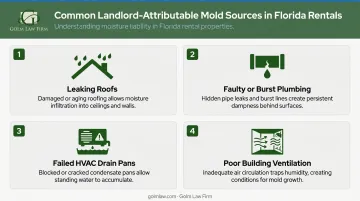
Each of these failure points also carries a code compliance dimension. In Manatee County and across Florida, violations tied to water damage or moisture can independently support a tenant's habitability claim — even if the landlord disputes whether mold is actually present.
What "Reasonable Time" Means and Mold Liability in Leases
Florida law does not set a specific statutory deadline for mold remediation. Courts assess reasonable time based on the severity of the mold, the scope of work required, and how promptly the landlord received notice and responded. Larger remediation jobs will naturally get more time; landlords who ignore notice entirely tend to fare poorly.
Proactive inspections — especially after storms, reported leaks, or plumbing failures — are the most effective way landlords can protect themselves. Mold caught early costs far less to remediate than a full-blown dispute.
Lease mold clauses are worth understanding before relying on them. Some Florida leases include provisions that attempt to shift mold liability to tenants after move-in — but these are not ironclad. Key limitations include:
- Fla. Stat. § 83.47 voids any lease provision that waives or limits statutory rights and remedies
- Clauses cannot override a landlord's structural maintenance duties under § 83.51
- If mold results from a failure the landlord was obligated to fix, no lease language eliminates that obligation
Tenant Rights and Remedies When a Landlord Won't Address Mold
Sending a 7-Day Notice Under Florida Statute 83.56
Before taking any legal action—withholding rent, terminating the lease, or filing suit—Florida law requires a tenant to deliver a written notice to the landlord. That notice must:
- Identify the specific mold problem clearly and in detail
- Demand remediation within 7 days
- State the tenant's intended action if the landlord fails to respond (rent withholding, lease termination, or both)
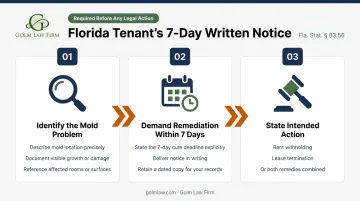
Florida law permits delivery by mail, hand delivery, email (if the lease allows it), or by leaving a copy at the residence if the tenant is absent. That said, USPS Certified Mail with Return Receipt Requested is the best practice—proof of receipt becomes critical evidence if the dispute reaches court.
This notice is not optional. Tenants who withhold rent or vacate without proper written notice lose significant legal protections and may face successful eviction proceedings. The Florida Bar's approved tenant notice form (Form 4) specifically cautions that skipping this step can severely affect tenant rights.
Rent Withholding, Lease Termination, and Lawsuits
Once that notice deadline passes without action, Florida law opens several paths forward.
Rent Withholding
Rent withholding is available under Fla. Stat. § 83.60 when the landlord's failure to remediate constitutes material noncompliance with § 83.51. Important caveats:
- Withholding rent almost always triggers an eviction lawsuit from the landlord
- The tenant must deposit withheld rent into the court registry
- Failure to deposit within 5 days of the hearing can waive all defenses other than payment
- The mold must be severe enough for a judge to classify it as material noncompliance
Lease Termination
When conditions are genuinely uninhabitable, a tenant may vacate and assert constructive eviction. This generally requires a separate 7-day notice of intent to vacate.
If a tenant vacates due to uninhabitable conditions, they owe no rent for the period the unit was uninhabitable. Landlords who dispute the termination may attempt to retain the security deposit or sue for unpaid rent.
Lawsuits for Damages
A lawsuit can recover remediation costs, damaged personal property, and alternative housing expenses. Personal injury claims for health effects are possible but face a high evidentiary bar.
Florida applies the Daubert standard under Fla. Stat. § 90.702, which requires expert testimony that reliably links specific health conditions to the mold in the unit. Medical records alone are rarely sufficient.
Repair and Deduct
This strategy—where a tenant hires a contractor and deducts the cost from rent—has no explicit statutory authorization in Chapter 83. Tenants who attempt it without legal guidance take significant risk. Consult an attorney before going this route.
Security Deposits and Mold in Florida Rentals
When tenants move out with a mold dispute unresolved, security deposits frequently become the next battleground.
Under Fla. Stat. § 83.49, landlords may deduct remediation costs from the security deposit if the tenant caused the mold—but the standard is damage beyond ordinary wear and tear, and strict procedural rules apply:
- 15 days to return the full deposit if no deductions are claimed
- 30 days to send written notice by certified mail itemizing claimed deductions, using the statutory language required by law
Landlords who miss the 30-day deadline or fail to use certified mail may forfeit the right to any deductions entirely. Tenants who believe their deposit is being wrongfully withheld should document their position carefully and seek legal counsel.
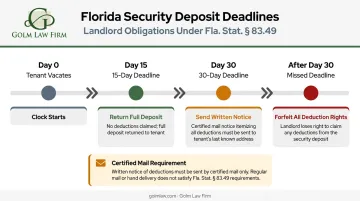
The core dispute in mold-related deposit cases is always causation: did the mold result from a structural failure (landlord's responsibility) or from the tenant's own conduct, such as failing to run the HVAC, blocking ventilation, or not reporting a known leak?
What determines who prevails is almost always documentation. Key evidence includes:
- Move-in inspection reports noting pre-existing conditions
- Photos taken throughout the tenancy showing the unit's condition
- Written communications about HVAC issues, leaks, or maintenance requests
How to Document Mold Issues in Florida: A Practical Checklist
In Florida mold disputes, documentation often determines who wins—whether that's proving a landlord ignored written notice or showing a tenant manufactured damage claims. Both landlords and tenants should start building their record the moment they discover a mold problem.
For both parties:
- Photograph and date all visible mold, water stains, and structural damage immediately
- Record video walkthroughs with timestamps—store copies in multiple locations
- Keep records of who performed any remediation work, including their DBPR license number
Tenants face distinct legal steps under Florida Statute § 83.51 that require precise paper trails to be effective:
For tenants specifically:
- Put every communication with the landlord in writing and retain copies
- Send the 7-day notice via USPS Certified Mail and keep the return receipt
- See a doctor promptly if experiencing health symptoms and keep all visit records and diagnoses on file
- Save all receipts for mold-related expenses: hotel stays, damaged belongings, out-of-pocket medical costs
Landlords need documentation that demonstrates timely, professional response—particularly if a dispute escalates to litigation:
For landlords specifically:
- Document all inspection dates, findings, and repair orders
- Retain contractor invoices, license verification records, and completion photos
- Respond to tenant notices in writing and keep copies of all correspondence
When to Contact a Florida Real Estate Attorney About Mold
Some mold situations can be handled through direct communication. Others escalate quickly, and the procedural stakes are high enough that going it alone carries real risk.
Tenants should seek legal counsel when:
- The landlord ignores or refuses to respond to the 7-day notice
- Remediation was performed but mold recurred, or was done by an unlicensed contractor
- The landlord filed an eviction lawsuit in response to rent withholding
- A significant security deposit dispute has arisen over who caused the mold
Landlords should seek legal counsel when:
- A tenant has sent a formal 7-day notice threatening to withhold rent or sue
- There is a genuine dispute over whether the mold was tenant-caused or structural
- Lease language related to mold liability needs review for enforceability
- An eviction proceeding is underway and the tenant has raised habitability as a defense
If any of these situations apply, getting qualified legal guidance early can prevent costly procedural missteps. Golm Law Firm, P.A., based in Bradenton, represents landlords and property owners across Manatee County and throughout Florida in real estate and landlord-tenant matters — from reviewing lease provisions and responding to tenant notices to full litigation representation. Crystal D. Golm is a member of the Florida Bar's Real Property, Probate & Trust Law (RPPTL) Section with extensive experience in these disputes. Consultations start at $150, and pre-litigation representation is available starting at $550 for limited-scope matters.
Frequently Asked Questions
How long does a landlord have to deal with mold?
Florida law sets no fixed mold remediation deadline. A tenant's written 7-day notice under Fla. Stat. § 83.56 creates the minimum threshold before legal action is available, but courts evaluate whether the landlord acted within a "reasonable time" based on the severity of the problem and the scope of work required.
What are my rights as a renter with mold in Florida?
Tenants have the right to a habitable unit under the implied warranty of habitability. If the landlord fails to remediate after receiving proper written notice, tenants may withhold rent, terminate the lease, or sue for damages, though each remedy requires following specific procedural steps.
Can you sue a landlord for mold in Florida?
Yes. Tenants can sue for breach of the implied warranty of habitability, property damage, and alternative housing costs. Personal injury claims for health effects are also an option, but they require strong medical documentation and expert testimony meeting Florida's evidentiary standards for scientific evidence.
Does Florida law require landlords to disclose mold before renting?
No. Florida has no statutory mold disclosure requirement for residential rentals. However, landlords who knowingly conceal mold conditions may face liability for intentional concealment, and all landlords must comply with applicable health and building codes.
Can a landlord deduct mold remediation costs from a security deposit in Florida?
Yes, if the tenant caused the mold beyond ordinary wear and tear. The landlord must send written notice by certified mail within 30 days of the tenant vacating, itemizing the claimed costs using statutory language, or risk forfeiting the right to any deductions.
What should tenants document when reporting mold to their landlord?
Document dated photographs of all mold and water damage, send all communications including the formal 7-day notice via certified mail, and retain any medical records and receipts for expenses attributable to the mold condition.