Chapter 83 is the governing framework for virtually every landlord-tenant relationship in Florida. It covers residential tenancies, commercial leases, and self-storage facilities — each under a separate part of the statute. This guide walks through the most consequential rules: security deposits, maintenance obligations, notice periods, the eviction process, prohibited practices, and the wave of legislative changes enacted between 2023 and 2025.
Key Takeaways
- Chapter 83 covers three areas: nonresidential tenancies (Part I), residential tenancies (Part II), and self-storage facilities (Part III)
- Security deposits must be returned within 15 days of move-out or a written claim notice sent by certified mail within 30 days
- Notice periods vary: 3 days for nonpayment, 7 days for lease violations, 30 or 60 days to terminate periodic tenancies
- Self-help eviction (changing locks, cutting utilities, removing doors) is illegal; only a court order and writ of possession can remove a tenant
- Florida now preempts all local landlord-tenant regulations statewide (§83.425, effective July 1, 2023)
Florida Chapter 83: Structure, Scope, and Who It Covers
Chapter 83 of the Florida Statutes is divided into three distinct parts:
| Part | Statute Range | Coverage |
|---|---|---|
| Part I | §§83.001–83.251 | Nonresidential/commercial tenancies |
| Part II | §§83.40–83.683 | Residential tenancies (Florida Residential Landlord and Tenant Act) |
| Part III | §§83.801–83.809 | Self-service storage facilities |
Most landlord-tenant questions — security deposits, maintenance, eviction, notices — fall under Part II. This guide focuses on Part II, since it governs nearly every common landlord-tenant dispute and obligation in Florida.
Who Part II Does Not Cover
Part II explicitly excludes certain arrangements under §83.42:
- Transient occupancy in hotels, motels, or mobile home parks
- Owners occupying their own condominium unit
- Occupancy under a contract of sale meeting statutory payment thresholds
- Residence in medical, geriatric, educational, counseling, or similar licensed facilities
If your situation involves one of these, Part II may not apply. Verify which statute governs your arrangement before assuming Chapter 83 protections apply.
The 2023 State Preemption Rule
Before 2023, cities like Miami, Tampa, and Orlando could impose local landlord-tenant regulations that went beyond state law. That changed with §83.425, which took effect July 1, 2023. The statute now preempts all local government regulation of residential tenancy matters covered under Part II — including screening, security deposits, application fees, lease terms, and notice requirements. Local ordinances cannot impose stricter rules on landlords than Chapter 83 allows.
With the structure and scope established, the sections below break down the specific rights and obligations that govern Florida rental relationships under Part II.
Security Deposits Under Florida Law
Florida sets no cap on the amount of a security deposit. What the statute controls strictly is how deposits must be held and when they must be returned.
How Deposits Must Be Held
Under §83.49(1), landlords have three compliant options:
- Non-interest-bearing account — a separate Florida banking institution account; funds cannot be commingled with landlord funds
- Interest-bearing account — tenant receives at least 75% of the annualized average rate or 5% simple interest per year, whichever the landlord elects
- Surety bond — posted with the clerk of the circuit court in the county where the property is located
Commingling deposit funds with personal or business accounts is prohibited regardless of which option the landlord chooses.
Written Disclosure Requirements
Landlords renting five or more individual dwelling units must provide written notice within 30 days of receiving a deposit. The notice must include:
- The depository name and address (or confirmation that a surety bond was posted)
- Whether interest is paid on the deposit
- The required statutory disclosure language beginning: "YOUR RENTAL AGREEMENT REQUIRES PAYMENT OF CERTAIN DEPOSITS..."
For tenants: providing a forwarding address when you move out is critical. The landlord sends claim notices to the last known address — missing that notice because you didn't update your address can affect your ability to dispute a claim.
The Post-Tenancy Deposit Timeline
| Event | Deadline | Consequence of Missing It |
|---|---|---|
| No landlord claim | Return deposit within 15 days | N/A |
| Landlord intends to claim | Send written notice by certified mail within 30 days | Forfeits right to impose any claim on the deposit |
| Tenant response to claim | Object in writing within 15 days | Landlord may deduct the claimed amount |
| No tenant objection | Landlord remits balance within 30 days of claim notice | — |
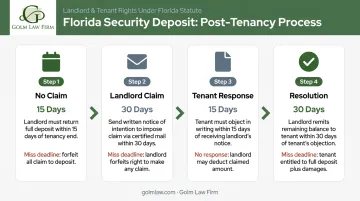
Failing to object within 15 days does not waive the tenant's right to file a separate damages action. It only permits the landlord to proceed with the deduction in the meantime.
The 2023 Fee-in-Lieu-of-Deposit Option
§83.491, effective July 1, 2023, allows landlords to offer a nonrefundable fee as an alternative to a traditional security deposit. Four rules govern how this works:
- The option is voluntary — landlords may offer it, not require it
- Tenants may terminate the fee agreement and switch to a traditional deposit instead
- The written agreement must include statutory disclosure language confirming the fee does not reduce the tenant's liability for rent or damages
- A landlord cannot use a tenant's acceptance or rejection of this option as a criterion for approving or denying occupancy
Landlord Maintenance Obligations and Tenant Duties
What Landlords Must Maintain
Under §83.51(1), every landlord must comply with applicable building, housing, and health codes. Where no codes apply, the landlord must keep roofs, windows, doors, floors, steps, porches, exterior walls, foundations, structural components, and plumbing in good repair.
For single-family homes and duplexes, these obligations can be modified in writing. At lease commencement, the landlord must install working smoke detection devices unless otherwise agreed in writing.
For all other residential units, landlords must also provide, unless otherwise agreed in writing:
- Pest extermination (rats, mice, roaches, ants, wood-destroying organisms, bedbugs)
- Functioning locks and keys
- Clean and safe common areas
- Garbage removal with outside receptacles
- Functioning heat, running water, and hot water
Tenant Responsibilities Under §83.52
Tenants carry reciprocal duties. They must:
- Keep the unit clean and sanitary
- Dispose of garbage properly
- Maintain plumbing fixtures in clean, sanitary, working condition
- Use appliances reasonably
- Avoid damaging, defacing, or removing landlord property
- Not disturb neighbors or breach the peace
The landlord is not responsible for conditions the tenant or their guests caused through negligence or wrongful conduct.
When a Landlord Fails to Maintain — Tenant Remedies
If a landlord materially fails to comply with §83.51(1), the tenant must deliver 7 days' written notice specifying the noncompliance and stating the intent to terminate or withhold rent. If the landlord doesn't cure within 7 days, the tenant's options depend on the severity:
- If the unit becomes untenantable: the tenant may vacate without rent liability for that period
- If the unit remains habitable but diminished: rent may be reduced proportionally to the loss of rental value
- Written notice is mandatory: skipping this step voids both remedies entirely
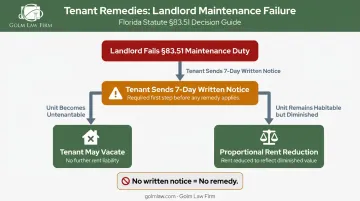
Keep copies of all written notices, landlord responses, and documentation of the condition before taking any rent withholding action.
Miya's Law (§83.515)
Tenant safety extends beyond physical maintenance. Enacted in 2022 following the death of Miya Marcano, §83.515 requires landlords of nontransient and transient apartment public lodging establishments to conduct background screening of all employees as a condition of employment.
Screening must check criminal history records and sexual predator/offender registries across all 50 states and the District of Columbia. Failure to comply exposes landlords to significant liability.
Termination Notices: Periods, Types, and Delivery
Periodic Tenancy Termination (§83.57)
For tenancies without a fixed end date, either party may terminate by giving written notice:
| Tenancy Type | Required Notice |
|---|---|
| Year-to-year | 60 days before end of annual period |
| Quarter-to-quarter | 30 days before end of quarterly period |
| Month-to-month | 30 days before end of monthly period |
| Week-to-week | 7 days before end of weekly period |
These notice periods apply to both landlords and tenants. Under §83.47, lease provisions that purport to waive Part II requirements — including these notice periods — are void and unenforceable.
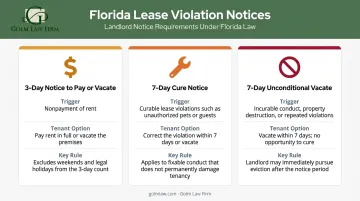
The Three Key Notices for Lease Violations (§83.56)
1. 3-Day Notice to Pay or Vacate (Nonpayment of Rent)
- Excludes Saturdays, Sundays, and court-observed legal holidays
- Must state the amount owed and the date by which payment or surrender is required
2. 7-Day Cure Notice (Curable Noncompliance)
- Used for violations the tenant can fix — unauthorized pets, failure to maintain cleanliness, unauthorized occupants
- Must identify the specific noncompliance and provide the opportunity to cure
3. 7-Day Unconditional Vacate Notice (Incurable Noncompliance)
- For conduct not subject to cure: intentional property destruction, unreasonable disturbances, or a repeated violation within 12 months of a prior written warning
- No opportunity to cure is required
Fixed-Term Lease Nonrenewal (§83.575)
A fixed-term lease may include a nonrenewal notice requirement. Key rules:
- Landlords may require up to 60 days' advance notice from the tenant before the end of the term
- If the landlord includes this requirement, they must notify the tenant at least 15 days before the notice period begins whether the lease will be renewed
- Failure by the tenant to give required notice can result in liquidated damages — but only if the lease properly discloses this consequence
Electronic Notice Delivery (§83.505, Effective July 1, 2025)
Email delivery of statutory notices is permitted, but only if both parties have signed a specific statutory addendum to the rental agreement. That addendum must include:
- Valid email addresses for each party
- Conspicuous voluntary-election language confirming informed consent
- Provisions for revocation of consent and address updates
Without the signed addendum, email delivery does not meet the statutory requirement — regardless of whether the message was received.
The Eviction Process Under Chapter 83
Self-Help Eviction Is Illegal
Under §83.67, a landlord may not:
- Shut off utilities (water, heat, electricity, gas, elevator, garbage collection)
- Change locks or use any device to prevent tenant access
- Remove outside doors, locks, roof, walls, or windows except for maintenance
- Remove a tenant's personal property without lawful authority
Violations constitute irreparable harm for purposes of injunctive relief and expose the landlord to liability for actual and consequential damages or three months' rent, whichever is greater, plus attorney's fees and costs. Only the sheriff may remove a tenant — and only after a court order and writ of possession.
The Formal Eviction Process (§83.59 and §83.60)
After proper notice and the tenant's failure to comply, the process follows these steps:
- File in county court where the property is located
- Tenant is served with the complaint
- Tenant has 5 days (excluding weekends and legal holidays) to pay accrued rent into the court registry or file a motion to determine rent — unless pleading payment
- Failure to deposit constitutes an absolute waiver of defenses (other than payment), and the landlord is entitled to an immediate default judgment for removal
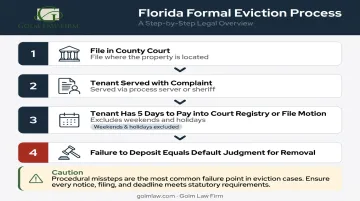
Procedural missteps are among the most common reasons evictions fail or get delayed — particularly errors around notice content, service method, and the court registry requirement. Golm Law Firm represents Florida landlords and property owners through each of these steps to avoid the pitfalls that derail otherwise valid evictions.
The Partial Rent Acceptance Trap (§83.56(5))
Accepting partial rent after posting a 3-day notice can invalidate the eviction. To preserve eviction rights after accepting partial rent, the landlord must do one of three things:
- Provide a written receipt noting the date, amount received, and agreed remaining balance
- Deposit the partial amount into the court registry when filing the eviction complaint
- Post a new 3-day notice reflecting the remaining balance due
Skipping these steps and proceeding on the original notice is a common mistake — Florida courts routinely dismiss evictions on this basis, forcing landlords to restart the entire notice process.
Prohibited Practices, Retaliation, and Required Disclosures
What Landlords Cannot Do
Beyond self-help eviction, §83.67 prohibits landlords from discriminating against servicemembers in tenancy offers or terms — one of several landlord conduct restrictions the statute addresses. All §83.67 violations carry the same damages standard: actual and consequential damages or three months' rent, whichever is greater.
Anti-Retaliation Under §83.64
Florida's anti-retaliation statute prohibits landlords from discriminatorily raising rent, reducing services, or threatening eviction when the primary motivation is retaliation against a tenant who:
- Filed a code complaint with a government agency
- Organized or joined a tenants' organization
- Complained to the landlord about habitability under §83.56(1)
- Exercised fair housing rights
- Terminated a rental agreement under servicemember protections
The tenant must have acted in good faith to raise this defense. A legitimate eviction for nonpayment of rent or an actual lease violation is not retaliation — the statute says so explicitly.
Required Disclosures
Three disclosures require careful attention:
| Disclosure | Timing | What It Must Cover |
|---|---|---|
| Landlord name and address (§83.50) | At or before tenancy commencement | Name and address of landlord or authorized agent to receive notices |
| Flood risk (§83.512) | At or before lease execution; effective October 1, 2025 | Separate document covering known flooding history, flood insurance claims, FEMA assistance received, and renter's insurance warning |
| Radon gas (§404.056) | At or before lease signing | Statutory radon warning on at least one document executed at signing |
The flood disclosure applies to residential leases of one year or longer. §83.512 took effect October 1, 2025 — landlords executing or renewing annual leases must have this disclosure in place.
Frequently Asked Questions
What are my legal rights as a tenant under Florida landlord-tenant law?
Florida tenants have several core protections under Chapter 83:
- Right to a habitable dwelling maintained to code
- Quiet enjoyment of the premises
- Advance written notice before entry or lease termination
- Security deposit returned within statutory deadlines
- Protection from self-help eviction
- Right to withhold rent after proper written notice if the landlord materially fails to maintain the premises under §83.51(1)
How many days' notice must a landlord give a tenant to move out in Florida?
It depends on the reason and tenancy type: 3 days for nonpayment of rent (excluding weekends and legal holidays), 7 days for curable or incurable lease violations, 30 days for month-to-month tenancies, and 60 days for year-to-year tenancies — all governed by §83.56 and §83.57.
What are the new rules for landlords under Florida landlord-tenant law?
Several significant changes took effect between 2023 and 2025:
- State preemption of all local landlord-tenant regulations (§83.425, July 2023)
- Fee-in-lieu-of-security-deposit option for tenants (§83.491, July 2023)
- Electronic notice delivery now permitted with a signed addendum (§83.505, July 2025)
- Mandatory flood risk disclosure for leases of one year or longer (§83.512, October 2025)
What is the "408 rule" under Florida landlord-tenant law?
No provision called the "408 rule" exists in Florida Chapter 83. If you've encountered this phrase, it may refer to a local ordinance, a misquoted statute number, or a provision from a different legal context. Consult a Florida attorney to identify what specific rule is actually being referenced.
Can a landlord keep my security deposit in Florida?
A landlord may only keep all or part of a deposit by sending written notice of the claim via certified mail within 30 days of tenancy termination, stating the specific reason. Missing that deadline forfeits the right to make any claim. Once the tenant receives the notice, they have 15 days to object in writing.