Introduction
For decades, Florida landlords had one problem with notice delivery: it had to be physical. Hand it to the tenant, mail it, or post it at the property. Sending a 3-day notice by email carried no legal weight — even if the tenant confirmed they saw it.
That changed on July 1, 2025, when Florida Statute 83.505 took effect under House Bill 615. The new law formally permits email delivery of legally required landlord-tenant notices — but with important conditions attached. Both parties must opt in through a signed written addendum. Without that addendum, email still has no legal standing.
This article breaks down §83.505 in practical terms: what it requires, which notices it covers, how timing works, and where landlords and property managers face real risk.
Key Takeaways:
- Email notices are legally valid only when both parties sign a written addendum designating specific email addresses
- Consent is fully voluntary and independently elected by each party
- An emailed notice is deemed delivered when sent, unless it bounces back
- Text messages, DMs, and social media messages are not authorized under this statute
- Traditional delivery methods remain fully valid alongside email
What Is Florida Statute 83.505 and Why Does It Matter?
Section 83.505 is a new addition to Part II of Chapter 83 — Florida's Residential Landlord and Tenant Act — formally titled "Electronic delivery of notices." It allows landlords and tenants to exchange legally required notices by email, making email a legally recognized delivery method under Florida landlord-tenant law.
A few important scope clarifications up front:
- Residential only. §83.505 applies exclusively to residential tenancies under Part II of Chapter 83. Commercial leases are not covered — Florida Realtors confirmed this explicitly in their July 2025 guidance.
- Written leases only. Because email authorization requires a signed addendum, oral rental agreements are also excluded by default.
- Additive, not replacing. Section 83.505(6) states clearly: "This section does not preclude service of notices by any other means permitted by law." Personal delivery, posting, and mail remain fully valid options.
Landlords managing multiple units can send notices instantly without tracking down certified mail receipts or coordinating in-person delivery, provided they've completed the opt-in process correctly.
The Written Addendum Requirement: How to Legally Opt In
Email delivery isn't authorized just because both parties exchanged addresses or agreed verbally. Florida Statute §83.505 sets specific requirements that must be met in writing.
What the Addendum Must Contain
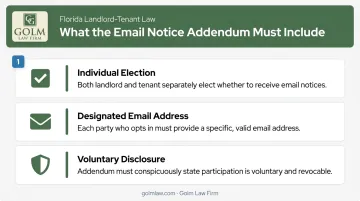
Under §83.505(1), the parties must sign an addendum to the rental agreement — not a clause buried in the main lease body, but a separate addendum. That addendum must:
- Have both the landlord and tenant individually elect whether or not to receive notices by email
- Designate a specific, valid email address for that purpose from each party who opts in
- Conspicuously advise both parties that participation is entirely voluntary and revocable at any time
The Voluntary Requirement Matters
Neither party can pressure the other into accepting email notices. The statute's model language makes this explicit: "The election to receive notices from the landlord by e-mail is voluntary" — and mirrors this for the landlord's side.
Elections Are Independent
The landlord and tenant make separate, independent elections. For example:
- The landlord may agree to receive email notices from the tenant while the tenant declines to receive them from the landlord
- The reverse is equally valid
- Both can opt in, or neither can
The Statutory Model Form
The statute provides model addendum language that can be used "substantially as written." Florida Realtors has also published an OED-1 form ("Opt-in for Electronic Delivery of Notices") based on this framework. Both work as a starting point. That said, landlords with specific circumstances may want an attorney to review whether the template language fully addresses their situation before relying on it for high-stakes notices.
Which Notices Can Be Sent by Email Under §83.505?
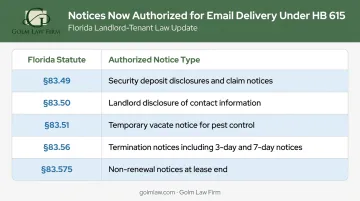
HB 615 amended several existing statutes to add email as a permitted delivery method. The table below covers the notice types now authorized for electronic delivery:
| Statute | Notice Type |
|---|---|
| §83.49 | Security deposit disclosures and claim notices (including the landlord's 30-day notice of intent to impose a claim) |
| §83.50 | Landlord disclosure of name, address, and contact information |
| §83.51 | Temporary vacate notice for pest control or extermination (7-day notice) |
| §83.56 | Termination notices — including 3-day nonpayment notices and 7-day notices for non-compliance or non-curable violations |
| §83.575 | Non-renewal notices at the end of a lease of specific duration |
Section 83.505(1) covers "any notices required under this part" — language broad enough that email may apply to other Part II notice requirements. That said, for notice types not explicitly listed in the amended statutes above, the applicability is less certain. If you're unsure whether a particular notice qualifies, consult a Florida real estate attorney before relying solely on email.
One Clear Limitation
Text messages, social media messages, and DMs are not authorized. The statute authorizes electronic delivery "via an e-mail address" — full stop. Notices sent by any other digital channel have no legal standing under Chapter 83.
How Email Delivery Works: Timing, Bouncebacks, and Record-Keeping
When Is an Email Notice Considered Delivered?
Under §83.505(4): a notice sent by email is deemed delivered at the time it is sent — not when the recipient opens or reads it. This is meaningful for time-sensitive notices like 3-day demands, where the clock matters.
The exception: if the email is returned as undeliverable (bounced back), delivery has not occurred.
What to Do If an Email Bounces
If a notice bounces back, switch to a traditional delivery method immediately:
- Personal delivery at the rental unit
- Posting the notice at the premises
- First-class mail to the last known address
Any applicable deadline — such as the 3-day nonpayment period before filing for eviction — runs from when proper delivery actually occurs, not from the failed email attempt.
Record-Keeping Requirements
Section 83.505(5) requires the sender to retain:
- A copy of the notice sent
- Evidence of email transmission — such as a screenshot of the sent folder, a delivery receipt, or a sent-email confirmation
Keep a dedicated folder or log for statutory notices. In an eviction or security deposit dispute, proof of transmission can be the difference between a valid claim and a dismissed one.
Updating or Revoking Consent
- Either party can update their designated email address at any time by providing written notice; the change takes effect upon delivery of that notice (§83.505(3)).
- Either party can revoke consent entirely by written notice. Revocation takes effect upon delivery and does not invalidate notices already properly sent before revocation (§83.505(2)).
Key Limitations and Practical Risks
Use Dual Delivery for High-Stakes Notices
Email delivery is convenient, but for notices with significant legal consequences — particularly non-renewal notices under §83.575 and 3-day nonpayment demands under §83.56 — consider delivering by email and by traditional means simultaneously.
The Florida Bar Journal has noted that a complaint based on a defective three-day notice cannot state a valid cause of action for eviction. A tenant who later claims non-receipt of an email could create serious problems if email was the only delivery method used.
Addendum Errors Can Invalidate the Notice
Sending to an email address not designated in the addendum — or emailing a notice when no signed addendum exists — will not meet statutory requirements. These mistakes can invalidate an eviction filing or a security deposit claim. The addendum needs to be in place before any notice is sent, not added retroactively.
Not All Notice Situations Are Straightforward
§83.505 explicitly covers several notice types, but Part II of Chapter 83 references "notice" in other sections without specifying the form. For any notice type not clearly listed in the amended statutes, the safest approach is to use traditional delivery until you have legal confirmation that email applies.
When compliance is uncertain, getting a professional review before sending a notice is far less costly than defending a defective eviction filing. Landlords in Manatee County and across Florida can schedule a consultation with Golm Law Firm, P.A. to confirm whether their addendum language and notice procedures are compliant — consultations start at $150 for a 30-minute phone session, or $350 for a 60-minute session with document review.
Frequently Asked Questions
What is electronic delivery of notices pursuant to section 83.505 Florida Statutes?
Section 83.505 is a Florida law effective July 1, 2025 that permits landlords and tenants to exchange legally required notices by email. Both parties must sign a written addendum to the rental agreement, designate valid email addresses, and acknowledge that participation is voluntary.
Can a 3-day notice be emailed in Florida?
A 3-day nonpayment notice can be emailed under §83.505, but only if a valid signed addendum is already in place. Without that addendum, the notice must be delivered by hand, mail, or posting at the property.
Is a text message considered a written notice in Florida?
No. Section 83.505 authorizes only email delivery — not text messages, social media messages, or any other digital format. Notices sent by text have no legal standing under Chapter 83.
Does Florida Statute 83.505 apply to commercial leases?
No. Section 83.505 applies only to residential tenancies under Part II of Chapter 83. Commercial landlord-tenant relationships are governed separately, and this statute does not extend to commercial leases.
What happens if an emailed notice bounces back as undeliverable?
If an email bounces, the notice is not considered delivered. The sender must immediately use a traditional delivery method: personal delivery, posting at the premises, or mail, to preserve legal deadlines.
Can a landlord or tenant revoke consent to receive email notices?
Yes. Either party can revoke consent at any time by providing written notice to the other party. Revocation takes effect upon delivery of that notice and does not invalidate email notices that were already properly sent before revocation.