Under Florida law, the answer is almost certainly yes. The doctrine of infancy gives minors the power to void most contracts, including residential leases, and Florida's courts and statutes have consistently reinforced that principle. For landlords and real estate investors in Manatee County, Sarasota, and across the state, understanding where this rule comes from — and how to protect against it — is essential before signing any lease.
This post covers the infancy doctrine under Florida common law, the key provisions of Chapter 743, the relevant case law, the exceptions that can limit a minor's right to disaffirm, and the practical steps landlords should take right now.
Key Takeaways
- In Florida, minors can disaffirm most contracts — including residential leases — at any time before or shortly after turning 18.
- A minor's contract is voidable, not void — only the minor can invoke this right, not the adult party.
- Chapter 743 creates narrow statutory exceptions: married minors, judicially emancipated minors, and certain foster-care youth.
- Adult co-signers remain bound even if the minor disaffirms — making co-signers a landlord's strongest protective measure.
- Kirton v. Fields, 997 So. 2d 349 (Fla. 2008) confirmed that Florida broadly protects a minor's right to disaffirm — even when the other party suffers a financial loss as a result.
What "Disaffirm" Means: The Doctrine of Infancy Under Florida Law
Disaffirmance means repudiating a previously entered agreement — refusing to be bound by it. Under the doctrine of infancy, a minor (anyone under 18 in Florida per §743.07) is presumed to lack the full legal capacity to enter binding contracts.
Voidable, Not Void
The distinction between these two terms has real consequences:
- A void contract has no legal effect from the outset — neither party is bound.
- A voidable contract is fully valid until the minor chooses to cancel it.
Only the minor holds the power to disaffirm — the adult landlord cannot use the tenant's age as an escape hatch. Florida courts confirmed this framework in Mossler Acceptance Co. v. Perlman, and it remains the controlling principle.
What Happens When a Minor Disaffirms
Under Florida authority from Putnal v. Walker, disaffirmance unwinds the contract and shifts the legal position of both parties:
- The minor is released from all further obligations under the lease.
- The minor may recover consideration already paid — such as a security deposit or prepaid rent.
- The minor need only return whatever consideration remains in their possession; if it has been used or disposed of, that does not defeat the disaffirmance.
Why the Rule Exists
The doctrine protects minors from their own inexperience and from adults who might take advantage of a young person's limited judgment. That rationale is particularly relevant in residential lease situations, where a 17-year-old may not fully understand multi-month rent obligations, early-termination consequences, or damage liability.
Florida preserves this common-law protection and reinforces it through Chapter 743, which governs the removal of minors' disabilities — including specific exceptions to the infancy doctrine that landlords should know.
Florida Chapter 743: The Statutory Framework
Chapter 743, titled "Disability of Nonage of Minors Removed," is the primary legislative framework governing minors' contractual capacity in Florida. Section 743.07 is the baseline: it removes all disabilities of nonage for persons 18 years of age or older, granting them full adult contracting rights.
Below that threshold, the statute creates only narrow, court-supervised exceptions — and understanding which exceptions exist is critical for landlords and tenants alike.
§743.045 — Foster-Care Youth and Residential Leases
This provision is the most directly relevant to residential leasing. Section 743.045 removes the disability of nonage for a specific, limited group:
- The youth has reached age 17
- Has been adjudicated dependent
- Is in the legal custody of the Department of Children and Families through foster care or subsidized independent living
Even then, the removal applies only "for the sole purpose of enabling a youth in foster care to execute a residential lease" upon turning 18. The youth must present a court order confirming this status.
The significance of this provision is straightforward: if the legislature needed to carve out a specific exception just to allow certain 17-year-olds to sign residential leases, the implication is clear. Absent that carve-out, minors generally cannot execute enforceable residential lease agreements.
Other Statutory Pathways
| Statute | Who It Covers | Effect |
|---|---|---|
| §743.01 | Married minors (or those previously married or widowed) | Full removal of nonage disability; can contract as an adult |
| §743.015 | Minors age 16+ with court petition | Circuit court may remove disabilities after reviewing best interests |
| §743.08 | Artistic, sports, entertainment contracts | Court approval makes the contract non-disaffirmable |
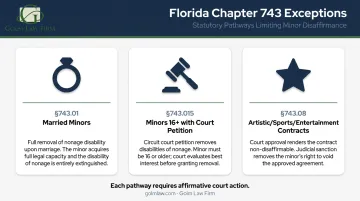
Each of these pathways is narrow and requires affirmative court action. A landlord who relies on a minor's signature — without confirming one of these statutory exceptions applies — still faces the risk of disaffirmance.
Florida Case Law: How Courts Have Addressed Minor Disaffirmance
Dedicated Florida appellate decisions on minor disaffirmance of residential leases are limited — no controlling Florida case directly addresses a tenant walking away from a lease based on minority alone. That gap means the risk is underappreciated, not litigated away.
Kirton v. Fields and Florida's Protective Posture
The clearest signal of how Florida courts approach minor protections comes from Kirton v. Fields, 997 So. 2d 349 (Fla. 2008). In that case, a parent signed a pre-injury liability release so a minor could participate in a commercial ATV activity. The minor was later killed. The Florida Supreme Court held the release unenforceable — a parent cannot prospectively waive a minor child's tort claims in a commercial setting.
The lesson for lease disputes: Florida courts are not inclined to let contractual formalities override a minor's legal protections. The state's parens patriae power — its role as protector of those who cannot fully protect themselves — weighs heavily in these decisions.
The legislature responded to Kirton by enacting §744.301(3), which allows natural guardians to release inherent-risk claims against commercial activity providers. Notice what the legislature did: it carved out a narrow, specific exception rather than broadly expanding adult authority over minor contracts. That pattern — narrow exceptions, not general bindings — runs throughout Florida's treatment of minor capacity.
Fraud as a Limit on Disaffirmance
One meaningful Florida exception emerged from Off the Wall & Gameroom LLC v. Gabbai, 301 So. 3d 281 (Fla. 4th DCA 2020). A 13-year-old used fraudulent information to complete a waiver and arbitration agreement at a trampoline facility. The court held the minor was estopped from invoking the infancy defense because the contract was procured through fraudulent misrepresentation.
Florida authority from Putnal v. Walker sets a three-part threshold for estoppel to apply:
- The minor's representations must have been fraudulently made
- The other party must have actually believed them
- The other party must have relied on them to their injury
Attempted deception that doesn't meet all three elements won't strip a minor of the disaffirmance right.
The Necessaries Doctrine: Shelter as a Special Case
Courts across the country recognize that minors cannot disaffirm contracts for necessaries — food, clothing, shelter, basic medical care. Florida's statutory framework in §743.015 treats shelter as part of the core necessities a minor must provide for in emancipation proceedings, supporting the view that housing carries special treatment.
No Florida appellate decision has directly applied the necessaries doctrine to hold a minor liable for rent under a residential lease. But the principle is available: even after disaffirmance, a minor who received and used housing may owe the reasonable value of that shelter under quasi-contract theory — not the full lease rate, but fair compensation for what was actually received.
Exceptions to Disaffirmance and Ratification After Majority
When a Minor Remains Bound
A minor cannot disaffirm a lease when one of the following applies:
- Disabilities of nonage have been judicially removed under §743.015 (requires circuit court petition, age 16+)
- The minor is or was married under §743.01
- The minor falls within the foster-care carve-out under §743.045
- The minor fraudulently misrepresented their age, and the landlord actually relied on that misrepresentation to their detriment
None of these exceptions applies automatically — each requires documented legal status or provable fraud. Landlords must verify each exception before relying on it.
Ratification: The Clock After the 18th Birthday
Once a minor reaches 18, the right to disaffirm does not disappear immediately — but it does expire. Florida general contract principles require disaffirmance within a reasonable time after reaching majority.
If the now-adult tenant continues paying rent, remains in the unit, or formally amends or renews the lease, a court may find implied ratification — treating the original lease as fully binding. Express ratification, such as signing a renewal or written affirmation, eliminates any ambiguity.
Critical rule: Disaffirmance must be of the entire contract. A minor cannot keep favorable terms while voiding unfavorable ones — it is all or nothing.
What Florida Landlords and Real Estate Investors Need to Know
The core risk is straightforward. If you lease to a minor — even unknowingly — that tenant can walk away at any point before their 18th birthday, or within a reasonable period after it. Your recourse may be limited to the returned security deposit, plus whatever a court determines is the reasonable value of shelter actually received.
Practical Protective Steps
The good news: most of the risk is avoidable with a few standard lease practices. Start with these steps before any lease is signed.
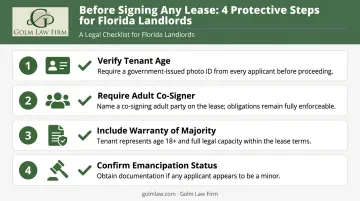
Before signing any lease:
- Verify tenant age during the screening process — require government-issued photo ID from every applicant.
- Require an adult co-signer (parent or guardian) as a named party on the lease; the co-signer's obligations remain fully enforceable even if the minor disaffirms.
- Include a warranty of majority — a lease clause in which the tenant represents and warrants they are 18 or older and have full legal capacity to contract.
- Ask about emancipation status if any applicant appears young — a minor with judicially removed disabilities can be bound, but you need documentation.
If you're already in a lease that may involve a minor, the steps shift from prevention to damage control.
If you already have a lease with a potential minor:
- Do not ignore the issue or assume the lease is enforceable.
- Pull the lease and assess what protections are already in place.
- Determine whether an adult co-signer is on the agreement.
Golm Law Firm, P.A. advises landlords and real estate investors across Manatee County, Sarasota, and surrounding Florida counties on lease structuring, contract review, and related real estate legal matters.
A 60-minute consultation with document review ($350) allows an attorney to evaluate your existing lease and identify any gaps in age-related protection. If you proceed with a new lease drafted by the firm — residential leases at a flat rate of $750 — the consultation fee applies toward that cost.
Frequently Asked Questions
Which contracts can a minor disaffirm in Florida?
In Florida, minors can generally disaffirm most contracts, including residential leases. Exceptions include contracts for necessaries (food, clothing, shelter, basic medical care), court-approved artistic or sports contracts under §743.08, and agreements where the minor's disabilities of nonage have been legally removed under Chapter 743.
Can a minor recover consideration after disaffirming a contract?
Yes. Upon disaffirmance, a minor is generally entitled to recover consideration paid — such as a security deposit or prepaid rent. The minor need only return whatever portion of that consideration they still possess. Courts may limit recovery if the minor misrepresented their age or received necessaries such as housing.
Can a minor disaffirm a contract selectively, voiding only some provisions?
No. Disaffirmance under Florida law applies to the entire contract. A minor cannot keep favorable lease terms while voiding unfavorable ones. Quasi-contractual liability for the reasonable value of necessaries received may survive disaffirmance, but the contract itself cannot be partially enforced.
What is the key Florida case on minor contract protections?
The common-law doctrine of infancy provides the foundation. The most significant modern Florida decision is Kirton v. Fields, 997 So. 2d 349 (Fla. 2008), in which the Florida Supreme Court held that parental pre-injury waivers are unenforceable in commercial contexts — reinforcing the judiciary's consistent protection of minors from binding obligations.
Does the necessaries doctrine apply to housing leases signed by minors?
Florida courts generally recognize shelter as a "necessary." A minor who received and used housing may owe the reasonable value of that shelter even after disaffirming the lease — though the lease itself cannot be enforced as written. Any liability arises under quasi-contract, not the lease itself.
What is the most effective protection for Florida landlords leasing to a minor?
Requiring a creditworthy adult co-signer as a named party on the lease is the strongest protection — the co-signer remains fully bound regardless of the minor's disaffirmance. Landlords should also verify tenant age during screening and consult a Florida real estate attorney before executing any lease where age is uncertain.