
Introduction
You're three weeks from closing on a Florida home when the seller calls to say they're backing out — a higher offer came in, and they want to cancel. Or you're the seller, and your buyer has gone silent, missed the deposit deadline, and won't return calls.
Both situations are breaches of contract. And in Florida's fast-moving real estate market, they happen far more often than most buyers and sellers expect.
This guide explains what qualifies as a breach under Florida law, how courts distinguish between material and minor breaches, what remedies are actually available, and what steps you need to take — before and after a dispute — to protect your position and enforce your rights.
Key Takeaways
- A breach occurs when a party fails to perform contractual obligations without a legally recognized excuse
- Florida distinguishes between material and minor breaches — the type determines available remedies
- Non-breaching parties may pursue deposit return, monetary damages, or specific performance
- FAR/BAR contracts require a 10-day deposit resolution period and mandatory mediation before any lawsuit can proceed
- Florida real estate contracts typically entitle the prevailing party to recover attorney's fees and costs
What Constitutes a Breach of Contract in Florida Real Estate
Under Florida law, a breach of contract occurs when a party fails to perform one or more contractual obligations without a legally recognized excuse. This applies equally to buyers, sellers, lenders, and any other party bound by the agreement.
The Five Elements You Must Prove
Florida's Standard Jury Instructions for Contract and Business Cases require a party claiming breach to establish:
- A valid contract existed between the parties
- The claimant performed their obligations, or had a valid excuse for non-performance
- All conditions required for the defendant's performance were met
- The defendant failed to perform something essential, or did something the contract expressly prohibited
- The claimant was harmed as a result
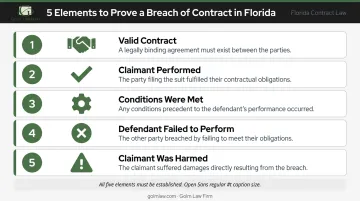
Without all five elements, a breach claim fails.
The FAR/BAR Contract Framework
These elements play out within a specific contractual framework. The FAR/BAR "As Is" Residential Contract for Sale and Purchase — approved by Florida Realtors and The Florida Bar — is the standard residential contract used across Florida. Its Paragraph 15 governs default and breach, setting out what each party may do when the other fails to perform.
Under Paragraph 15:
- If the buyer defaults, the seller may retain the deposit as liquidated damages or seek specific performance
- If the seller defaults, the buyer may receive the deposit back without waiving other damages, or may seek specific performance
Time of the Essence and Closing Deadlines
When a contract includes a "time of the essence" clause, missing the closing date is itself a breach — no additional notice or demand is required. Without that language, the analysis is more nuanced. Florida courts have held (Henry v. Ecker, 415 So.2d 137) that where time is not made of the essence, a breach for missed closing typically requires a demand for performance at a reasonable time and place, followed by refusal.
The First Material Breach Doctrine
One overlooked issue: the party who first materially breaches a contract may lose the right to enforce it against the other side. The Florida Bar Journal's analysis of Florida's prior breach doctrine confirms that a prior material breach of a dependent covenant can discharge the non-breaching party's further obligations — though that defense can be waived if the non-breaching party continues performing after discovering the breach.
Material Breach vs. Minor Breach in Florida
The distinction between a material and minor breach is one of the most consequential questions in any Florida real estate dispute.
Material Breach
A material breach is a failure that goes to the heart of the contract — one that substantially deprives the non-breaching party of the benefit they bargained for.
Example: A seller refuses to convey the property after the buyer satisfies every condition — the inspection period has closed, financing is approved, and the buyer is ready to close. That refusal is a textbook material breach.
A material breach entitles the non-breaching party to:
- Terminate the contract
- Sue for monetary damages
- Seek specific performance
Minor (Non-Material) Breach
A minor breach is a less significant violation that doesn't defeat the contract's core purpose.
Example: A seller fails to leave the refrigerator that was listed in the contract but conveys the property otherwise as agreed. The buyer can't terminate over this — but may recover actual damages if they can prove loss.
How Florida Courts Assess Materiality
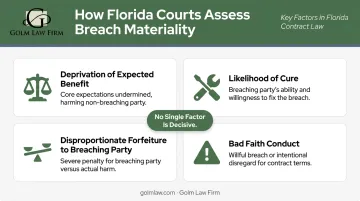
Florida courts apply factors drawn from the Restatement (Second) of Contracts, Section 241:
- How much is the non-breaching party deprived of their expected benefit?
- Can the breach be cured, and how likely is a cure?
- Would the breaching party suffer disproportionate forfeiture?
- Was the breach accompanied by bad faith?
Courts weigh all four factors together — no single element is decisive.
Concealed Defects: When Non-Disclosure Becomes Breach
The Florida Supreme Court's ruling in Johnson v. Davis, 480 So.2d 625 (1985), established that sellers have a duty to disclose facts materially affecting property value that are not readily observable and not known to the buyer. Depending on the specific contract representations, a seller's knowing concealment of material defects can give rise to both a breach of contract claim and a fraud claim. That distinction matters: fraud opens the door to additional remedies — including punitive damages — well beyond what a standard breach claim provides.
Common Breach of Contract Scenarios in Florida Transactions
Florida real estate contracts fail in predictable ways. Understanding which party breached — and how — determines what remedies are available. Below are the most common scenarios organized by who defaulted and where the contract process broke down.
Seller-Side Breaches
The most frequent seller breaches involve:
- Refusing to close after the buyer satisfies all conditions, including expiration of the inspection period and loan approval
- Failure to disclose known material defects — roof leaks, plumbing failures, or prior flood damage
- Pursuing a higher offer by attempting to back out after the contract is fully executed
Buyer-Side Breaches
Common buyer defaults include:
- Failing to secure financing without properly invoking the financing contingency before its deadline
- Refusing to close without a valid contractual basis after the inspection period expires
- Missing deposit deadlines — under the FAR/BAR contract, failure to deposit funds on schedule is an expressly stated default
Buyer and seller defaults are often straightforward. Contingency-related breaches are trickier — they turn on whether the correct procedure was followed, not just whether a condition existed.
Contingency-Related Breaches
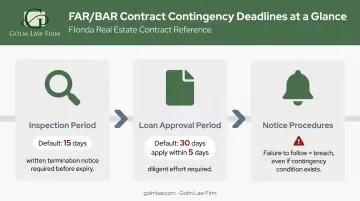
Under the FAR/BAR AS IS contract, each contingency window carries specific procedural requirements:
- Inspection period defaults to 15 days — buyers who want to terminate must provide written notice before this period expires; silence is not termination
- Loan approval period defaults to 30 days — buyers must apply within 5 days, use diligent effort, and timely notify the seller of approval or inability to obtain it
- Notice procedures — failing to follow them can itself constitute a breach, even when the underlying contingency condition genuinely existed
Nationally, NAR's Realtors Confidence Index reports roughly 5% of contracts are terminated and 14% experience delayed settlements — figures that reflect how often these procedural issues arise.
Legal Remedies Available to Non-Breaching Parties
Deposit Return
When a seller breaches, the buyer's most straightforward remedy is demanding return of the escrow deposit. This is often the fastest path to resolution, but choosing deposit return typically means waiving other damages claims arising from the same breach.
Monetary Damages
Non-breaching parties can sue for multiple categories of damages:
- Actual out-of-pocket losses — inspection fees, loan origination costs, moving expenses incurred in anticipation of closing
- Benefit-of-the-bargain damages — if the property's fair market value exceeds the contract price, the difference may be recoverable (Port Largo Club, Inc. v. Warren, 476 So.2d 1330)
- Consequential damages — foreseeable losses flowing from the breach, subject to proof of causation
Specific Performance
When a buyer genuinely wants the property — not just money — specific performance is the appropriate remedy. A court order compels the seller to complete the transaction on the original terms.
Critical step: When pursuing specific performance, a lis pendens must be filed in the public records under Florida Statute § 48.23. This puts third parties on notice and prevents the seller from conveying the property to another buyer during litigation. Note that a lis pendens is effective for one year from filing unless extended by court order.
Rescission
Rescission unwinds the entire transaction and restores both parties to their pre-contract positions. It's appropriate when the breach is so fundamental — or when fraud or material misrepresentation is involved — that completing the deal is no longer viable.
Attorney's Fees and Costs
The FAR/BAR contract entitles the prevailing party to recover attorney's fees and litigation costs. This provision cuts both ways: it can motivate a stronger legal position, but it also raises the stakes of losing.
Consulting with a Florida real estate attorney before filing helps evaluate the realistic cost-benefit of litigation versus settlement. Golm Law Firm offers pre-litigation services starting at $550 and hourly litigation representation at $475/hour with retainers beginning at $5,000 — giving clients a clear picture of costs before committing to a legal strategy.
Required Steps Before Filing a Lawsuit in Florida
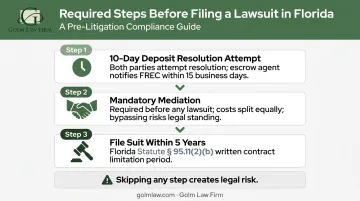
The FAR/BAR contract establishes a mandatory dispute resolution sequence. Skipping any step creates legal risk.
Step 1: 10-Day Deposit Resolution Attempt
When conflicting demands for the escrow deposit are made, FAR/BAR Paragraph 16(a) requires both parties to attempt resolution within 10 days. If unresolved, the matter proceeds to mediation.
The escrow agent cannot simply release the funds. Florida Administrative Code Rule 61J2-10.032 imposes specific obligations on licensed broker escrow agents:
- Notify FREC within 15 business days of receiving conflicting demands
- Begin a settlement procedure within 30 business days
Step 2: Mandatory Mediation
If the 10-day resolution attempt fails, mediation is required before any lawsuit can be filed. Key details:
- Mediation costs are typically split equally between the parties
- Each party pays their own attorney's fees during mediation
- Bypassing mediation and filing directly can jeopardize a party's legal position
Step 3: Know Your Deadline
Under Florida Statute § 95.11(2)(b), parties have five years from the date of breach to file suit on a written contract. That window feels comfortable until it isn't. Witness memories fade, documents go missing, and delays hand the other side time to build their defense. Speaking with a Florida real estate attorney shortly after a suspected breach keeps your evidence intact and your remedies open.
Defenses to a Breach of Contract Claim
Valid Contractual Excuse
A party accused of breach may show they exercised a contractual right properly. Under the FAR/BAR AS IS contract, a buyer who delivers written notice of termination before the inspection period expires — invoking their "sole discretion" termination right — has not breached. The same logic applies to financing contingencies: a buyer who properly invokes the contingency before its deadline has a complete defense.
First Material Breach by the Other Party
A defendant can argue the claimant was the first to materially breach, which excused the defendant's subsequent non-performance. Courts examine the full timeline and conduct of both parties. A defendant waives this defense, however, by continuing to perform after discovering the other party's breach.
Impossibility or Frustration of Purpose
In limited circumstances — such as destruction of the property before closing — a party may claim performance became objectively impossible through no fault of their own. Florida courts apply this doctrine narrowly. Where the risk was foreseeable or already allocated by the contract, the defense typically fails.
Common scenarios where impossibility is rejected by Florida courts include:
- Market downturns or financing difficulties the buyer could have anticipated
- Title issues that a standard due diligence process would have revealed
- Regulatory delays that were foreseeable at the time of contracting
- Seller inability to close due to a pre-existing lien or encumbrance
Frequently Asked Questions
What is the statute of limitations for breach of contract in a Florida real estate deal?
Florida Statute § 95.11(2)(b) provides five years from the date of breach to file suit on a written contract. Waiting too long permanently bars recovery, making early legal consultation essential after any suspected breach.
Can a buyer back out of a Florida real estate contract without losing their deposit?
Yes — during the inspection period under the FAR/BAR AS IS contract, a buyer may terminate at their sole discretion and recover their full deposit. After the inspection period expires, backing out without a valid contractual basis typically results in deposit forfeiture.
What happens to the escrow deposit when there is a breach of contract in Florida?
The escrow agent cannot unilaterally release a disputed deposit. The FAR/BAR contract requires a 10-day resolution attempt followed by mediation, and if still unresolved, the parties proceed to litigation or negotiate a mutual release.
Is mediation required before suing for breach of a Florida real estate contract?
Yes. The FAR/BAR contract mandates mediation as a prerequisite to litigation after the 10-day deposit resolution period. Bypassing this step can weaken the non-complying party's standing in court.
Can a seller keep the buyer's deposit after a breach in Florida?
If the buyer is in default under the FAR/BAR contract, the seller may elect to retain the deposit as liquidated damages — but only after following the contractual dispute resolution process. A seller cannot simply take the funds without completing the required steps.
What is the difference between suing for damages and suing for specific performance in Florida?
A damages suit seeks monetary compensation for losses caused by the breach. Specific performance asks the court to compel the breaching party to complete the transaction — the better option when no financial award could replace that exact property.