According to NFPA's 2024 research on smoke alarms in US home fires, 43% of home fire deaths occurred in properties with no smoke alarms, and nearly 59% of home fire deaths involved properties with either no alarms or alarms that failed to operate. For landlords, that statistic isn't just sobering—it's a legal and moral argument for getting this right.
This article breaks down what Florida law actually requires, where landlords commonly go wrong, and what happens when they don't comply.
Key Takeaways
- F.S. 83.51 requires landlords to install working smoke detectors before move-in—single-family/duplex rules differ from multi-unit building codes
- Multi-unit landlords must comply with applicable building and housing codes rather than F.S. 83.51 directly
- Battery-operated detectors must use 10-year tamper-proof sealed lithium batteries—standard 9-volt models do not satisfy F.S. 553.883
- Responsibility can shift to tenants via a written lease clause, but the landlord must still provide a compliant, working device before move-in
- Carbon monoxide detectors are separately required under F.S. 553.885 for buildings permitted on or after July 1, 2008
- Landlords who fail to comply risk lease termination, civil liability, and insurance claim denials
Florida Statute 83.51: What the Law Actually Requires
F.S. 83.51 is the primary landlord maintenance statute, and it draws a meaningful line between property types.
Single-Family Homes and Duplexes
Under F.S. 83.51(2)(b), unless otherwise agreed in writing, the landlord of a single-family home or duplex must install working smoke detection devices at the commencement of the tenancy. This is a specific, affirmative obligation—not something that can be overlooked or assumed to carry over from a prior tenant.
Apartments and Multi-Unit Buildings
For all other dwelling units, F.S. 83.51(1) governs: landlords must comply with applicable building, housing, and health codes. In practice, this means the Florida Building Code (discussed below) supplies the specific smoke alarm requirements for apartments and multi-unit buildings.
What Qualifies as a "Smoke Detection Device"
The statute defines this precisely. A qualifying device must:
- Detect visible or invisible particles of combustion
- Be electrical or battery-operated
- Be listed by Underwriters Laboratories (UL), Factory Mutual Laboratories, or another nationally recognized testing laboratory using accepted testing standards
A device that isn't listed by one of these laboratories does not satisfy the law, regardless of whether it functions.
F.S. 83.51(3) adds a hierarchy rule: if the duty under subsection (1)—code compliance—is the same or greater than the duty under subsection (2), subsection (1) governs. This becomes relevant when a landlord's property straddles both categories or when local code imposes stricter standards than the baseline statute.
Local codes in Manatee County and other Florida municipalities may impose additional requirements beyond state law. Landlords should verify with their local building department rather than assume the state statute sets the ceiling.
The 10-Year Tamper-Proof Battery Rule: A Common Compliance Pitfall
This is where many landlords unknowingly fall out of compliance.
What F.S. 553.883 Requires
Under F.S. 553.883, when a battery-powered smoke alarm is newly installed or replaces an existing battery-powered alarm as part of a repair or level 1 alteration in a one-family or two-family dwelling or townhome, it must be powered by a nonremovable, nonreplaceable battery that powers the alarm for at least 10 years.
In plain terms: if you're replacing a smoke detector in a covered property, you cannot install a standard 9-volt battery model. It must be a sealed 10-year unit.
Why "Tamper-Proof" Matters
The sealed battery design prevents tenants from removing the battery—one of the most common reasons detectors fail during actual fires. A standard 9-volt alarm may look identical to a compliant unit on a shelf at a hardware store. The difference is legally significant.
Cost comparison:
| Detector Type | Approximate Cost |
|---|---|
| 10-year sealed battery (compliant) | $35–$55 per unit |
| Standard 9-volt battery (non-compliant for covered replacements) | $17–$28 per unit |
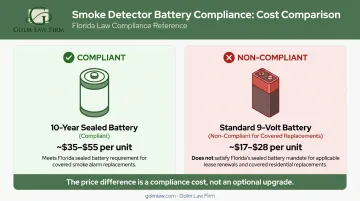
That price gap is a compliance cost, not an optional upgrade.
Exceptions to the Rule
F.S. 553.883 does not apply to alarms that are:
- Electronically connected as part of a centrally monitored or supervised alarm system
- Using low-power radio frequency wireless communication signals
- Multi-sensor combination devices (such as smoke/CO combos) listed by a nationally recognized testing laboratory
Detector Expiration
Smoke detectors don't last forever. The NFPA and manufacturers set the effective lifespan of sealed 10-year battery alarms at 10 years. Check the manufacture date printed on the back of any existing detector. Even a device that appears functional should be replaced once it has passed its manufacture date. When in doubt, replace it with a compliant 10-year sealed unit.
Where Smoke Detectors Must Be Placed in Florida Rentals
Placement requirements come from the Florida Building Code, not F.S. 83.51 alone.
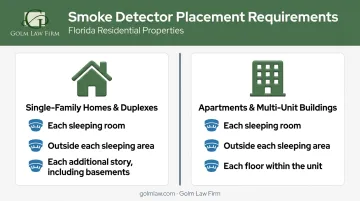
Single-Family Homes and Duplexes
The 2023 Florida Building Code, Residential, Section R314 requires smoke alarms complying with NFPA 72 and listed under UL 217 to be installed in:
- Each sleeping room
- Outside each separate sleeping area, in the immediate vicinity of bedrooms
- On each additional story, including basements and habitable attics (excluding crawl spaces and uninhabitable attics)
Apartments and Multi-Unit Buildings
The 2023 Florida Building Code, Building, Section 907.2.11 applies to Group R occupancies, which covers most apartment buildings. Required placement locations within each unit include:
- Each sleeping room
- Outside each separate sleeping area, in the immediate vicinity of bedrooms
- On each floor within the unit
Documentation Tip
Regardless of property type, landlords should document detector placement, model numbers, and installation dates in writing at move-in—either as part of a move-in checklist or a lease addendum. This creates a defensible record of compliance if a dispute arises.
Carbon Monoxide Detectors: Florida's Separate Requirement Under F.S. 553.885
Smoke detectors and CO detectors are governed by completely separate statutes. Landlords who conflate the two obligations risk compliance gaps on both fronts.
F.S. 553.885 requires CO alarms in every separate building or addition to an existing building (other than hospitals, inpatient hospice facilities, or nursing homes) where the building permit was issued on or after July 1, 2008, and the building has:
- A fossil-fuel-burning heater or appliance
- A fireplace
- An attached garage
- Any other feature that emits carbon monoxide as a byproduct of combustion
When the requirement applies, place one approved, operational CO alarm within 10 feet of each room used for sleeping purposes.
The statute does not apply to alterations or repairs to existing buildings. It does apply, however, if the work constitutes an addition — meaning an extension or increase in floor area, number of stories, or height. Landlords whose properties had additions permitted after July 1, 2008, may still be subject to the requirement even if the original structure predates that threshold. When in doubt, verify with the local building department.
Can a Landlord Make a Tenant Responsible for Smoke Detectors?
Yes—but only up to a point, and only in writing.
What the Law Allows
F.S. 83.51(2)(b) uses the phrase "unless otherwise agreed in writing," which means a landlord and tenant can modify the default smoke detector obligation through the lease. In practice, this allows a landlord to include a written clause shifting ongoing maintenance responsibility to the tenant. That typically covers:
- Testing the detector periodically
- Reporting malfunctions to the landlord promptly
- Replacing batteries in non-sealed units
What It Doesn't Allow
The written agreement does not eliminate the landlord's initial obligation. Before the tenant takes possession, the landlord must still provide a working, code-compliant smoke detector. That baseline cannot be delegated away through any lease language.
A verbal agreement to shift responsibility is not legally sufficient—the statute expressly requires the modification to be in writing.
Practical Caution
Even with a written maintenance clause in place, landlords should still document detector condition at move-in. If a tenant later disables or removes a detector and a fire occurs, the landlord may face scrutiny about the adequacy of the original installation and the clarity of the lease language. Move-in documentation is straightforward to collect and provides a clear record if a dispute arises later.
Getting the written clause right matters. Golm Law Firm drafts residential leases for Florida landlords that address statutory compliance provisions like these. Lease drafting is available at a flat rate of $750; landlords who want an existing lease reviewed for gaps can schedule a 60-minute consultation with document review for $350.
Legal Consequences When a Florida Landlord Fails to Comply
Missing smoke detector requirements isn't a technicality—it's a habitability violation with real legal exposure.
Tenant Remedies Under F.S. 83.56
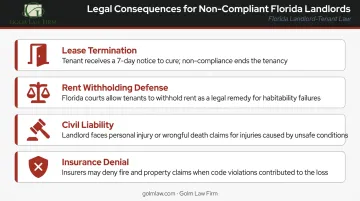
Under F.S. 83.56(1), a tenant can provide written notice specifying the noncompliance. If the landlord fails to cure within 7 days, the tenant may terminate the lease. That's a potential vacancy and turnover cost on top of any legal dispute.
Rent Withholding
Contrary to what some landlords assume, Florida law does provide a conditional rent withholding mechanism. Under F.S. 83.60, a tenant who has given proper statutory notice may raise a material noncompliance defense in an eviction action—and may withhold rent pending court determination, subject to paying accrued amounts into the court registry. It's a procedurally demanding remedy, but courts have allowed it.
Civil Liability
If a fire occurs in a unit that lacked a working, code-compliant smoke detector, the landlord can face personal injury or wrongful death claims. Courts evaluating negligence will ask whether a legally required safety device was missing and whether that gap contributed to the harm.
The exposure is significant. NFPA reports that three of five home fire deaths occur in homes with no working smoke alarms—a statistic that is difficult for any landlord to overcome in a negligence case.
Insurance Implications
Civil liability isn't the only financial risk. Many property insurance policies require compliance with applicable building codes and safety standards. A non-compliant smoke detector situation could give an insurer grounds to deny or reduce a fire-related claim.
That leaves the landlord personally responsible for property damage costs—on top of any civil exposure from injured tenants.
Landlords managing multiple units, older buildings, or properties that have changed use over time carry the greatest compliance risk. The exposure is layered: lease termination, rent withholding defenses, personal injury claims, and potential insurance denials can all stem from a single missing detector. Golm Law Firm works with landlords across Florida, including in Manatee County, to identify compliance gaps before they become costly disputes. A proactive review costs far less than defending any one of these claims.
Frequently Asked Questions
How many smoke detectors does Florida law require?
Florida statute doesn't set a fixed number. Placement requirements come from the applicable building code: generally one in each bedroom, one outside each sleeping area, and one on each floor. Single-family homes and duplexes must have working smoke detection devices installed at the start of the tenancy.
Can I sue my landlord for not having smoke detectors?
Yes. A tenant may have grounds to sue a landlord who failed to install or maintain a required smoke detector, especially if that failure contributed to injury or property loss. Document the non-compliance in writing and consult a Florida attorney about your options.
What type of smoke detector is legally required in Florida?
Florida requires smoke detection devices listed by a nationally recognized laboratory (UL or FM). For battery-operated models in covered replacements, the detector must use a sealed 10-year tamper-proof lithium battery—standard 9-volt models do not satisfy F.S. 553.883.
Are carbon monoxide detectors required in Florida rentals?
CO detectors are required under F.S. 553.885 in buildings permitted on or after July 1, 2008 that have a fossil-fuel appliance, fireplace, or attached garage. Detectors must be placed within 10 feet of each sleeping area.
Can a landlord make the tenant responsible for smoke detector maintenance?
Yes, through a written lease clause. But the landlord must still install a working, compliant detector before the tenancy begins—the initial installation obligation cannot be transferred to the tenant regardless of what the lease says.
Do battery-operated smoke detectors expire?
Yes. Smoke alarms have a useful life of approximately 10 years. Check the manufacture date on the back of the device—an expired detector must be replaced with a compliant 10-year tamper-proof unit, even if it still seems to work.