Key Takeaways
- Tampa's commercial zoning is governed by Chapter 27 of the Land Development Code and the Imagine 2040 Comprehensive Plan
- Repeat zoning violations can trigger fines of up to $500 per day under Florida Statutes Section 162.09
- Commercial districts range from CN (neighborhood-scale) to CBD (downtown high-density), each with distinct permitted uses
- Alcohol sales, certain service businesses, and other uses require a special use permit and public hearing
- Always confirm a property falls inside city limits before assuming Tampa zoning rules apply — a local mailing address is not enough
Tampa's Zoning Framework: How the City Governs Commercial Land Use
Tampa land use operates as a two-step system. Understanding both layers is essential before buying, leasing, or developing any commercial property.
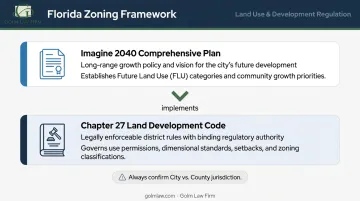
Imagine 2040 Comprehensive Plan — The Imagine 2040: Tampa Comprehensive Plan, last updated in 2016, sets the city's long-range growth management policy. It establishes Future Land Use categories that determine what intensity of development — commercial, residential, or mixed-use — is appropriate on a given parcel. Think of it as the policy ceiling.
Chapter 27 of the Land Development Code — Chapter 27 of Tampa's Code of Ordinances is where enforceable zoning rules live. It implements the Comprehensive Plan at the parcel level through specific districts, use permissions, dimensional standards, parking requirements, and approval procedures.
Here's a quick due-diligence reference:
| Question | Where to Look |
|---|---|
| What is the long-term land use category? | Imagine 2040 Comprehensive Plan + Future Land Use Map |
| What zoning district applies? | Chapter 27 + City's official zoning maps |
| Is this property inside City limits? | Tampa City Limits Map |
| If outside City limits, what rules apply? | Hillsborough County's separate Land Development Code |
The City/County Jurisdiction Split
Investors frequently overlook this distinction, sometimes at significant cost. A Tampa mailing address does not mean a property falls within the City of Tampa's jurisdiction.
Properties outside city limits are governed by Hillsborough County's Land Development Code — an entirely separate regulatory framework with different districts, use permissions, and approval processes. Confirm jurisdiction on the City's official limits map before any due diligence proceeds under Chapter 27.
Tampa's Commercial Zoning Districts: A Breakdown
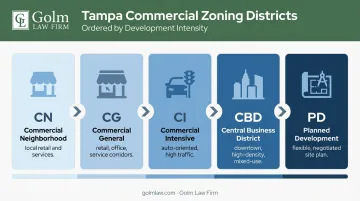
Tampa's commercial districts are defined in Section 27-156 of the LDC and organized by intensity — from small neighborhood retailers to high-density downtown uses. Table 4-1 of the LDC serves as the primary reference for permitted uses within each district.
Lower-Intensity Commercial Districts
- CN (Commercial Neighborhood): Designed for small-scale retail and services that primarily serve nearby residents. Think local cafes, dry cleaners, and convenience stores — not big-box retail.
- CG (Commercial General): The most common commercial designation in Tampa. Permits a broader range of retail, office, and service uses across strip centers and mixed-use corridors.
Higher-Intensity Commercial Districts
- CI (Commercial Intensive): Permits auto-oriented uses, larger retail formats, and operations that generate higher traffic volumes. Specific setback and screening requirements apply where CI zones border residential areas.
- CC (Commercial Corridor): Appears in City LDC update materials as a corridor-focused commercial classification. Verify its current status directly in Chapter 27 before relying on it for any transaction or development decision.
Central Business District (CBD)
The CBD designation applies to Downtown Tampa and carries greater height allowances, reduced parking minimums, and a strong emphasis on pedestrian-oriented design and vertical mixed-use development. Confirm current height limits and parking ratios in Chapter 27 tables before making any development decisions — these figures are updated periodically.
Planned Development (PD)
The PD designation offers flexibility for larger, complex, or mixed-use projects. Rather than applying a standard set of district rules, PD approvals are negotiated with the City and tied to a specific site plan. In practice, this can mean reduced setbacks, taller structures, or a broader mix of uses than any standard commercial district permits by right.
A Note on "C-3" Zoning
"C-3" appears occasionally in informal conversations about Tampa commercial properties, but this designation does not appear as an active classification in Tampa's current LDC. Always verify the applicable district directly in Chapter 27 or on the City's official zoning maps — not shorthand from a listing or prior transaction.
What Is Allowed in Commercial Zones: Permitted, Conditional, and Special Uses
Every commercial zoning district in Tampa categorizes uses into three tiers. Table 4-1 of the LDC — the Schedule of Permitted, Accessory, and Special Uses by District — is the definitive reference. Review it before signing a lease or submitting a permit application; skipping this step can derail approvals or void lease assumptions.
Permitted Uses (By Right)
These require no special approval beyond standard permitting. In general commercial districts, typical permitted uses include:
- Retail stores
- Restaurants and food service establishments
- Office uses
- Personal service businesses (salons, tailors, etc.)
- Banks and financial services
Conditional Uses
Conditional uses may be compatible with a district but require case-by-case review. Before granting approval, the City evaluates:
- Traffic generation from the proposed use
- Hours of operation and potential neighborhood impact
- Proximity to residential uses and sensitive land uses
The process is less intensive than a full special use permit but still involves staff review and sometimes public notice.
Special Uses — Including Alcohol Sales
Special use permits involve a public hearing and, in many cases, review by the Tampa City Council. Alcohol sales are the most frequently overlooked trigger.
Under Tampa's Special Use 2 Alcoholic Beverage (AB2) process — updated August 2024 — any business seeking to sell alcohol for on- or off-premises consumption must:
- Submit an application online through the City's Accela Citizen Access system
- Receive a tentative public hearing date at submission
- Demonstrate compliance with separation requirements
Demonstrate compliance with separation requirements
Separation distances vary by context: 1,000 feet from residential uses applies in most zoning situations, with reduced distances available in certain Urban Village or Mixed Use Corridor settings.
Restaurant operators and retailers who skip this step routinely discover the requirement after signing a lease, triggering costly delays or forcing a complete rethink of their business model.
Accessory Uses
Unlike the permit-intensive categories above, accessory uses support the primary use of a property — a storage room behind a retail shop, a generator pad for an office building — and are generally permitted by right. They remain subject to setback and size limitations under Chapter 27.
Development Standards for Commercial Properties in Tampa
Zoning controls more than just what you can do on a property — it dictates how you can build. Chapter 27 regulates:
- Minimum lot size and dimensions
- Maximum building height
- Front, rear, and side setbacks
- Lot coverage (the percentage of a lot a building may occupy)
- Floor area ratio (FAR) — total building floor area relative to lot size
Exact figures vary by district and should be verified in current Section 27-156 tables before proceeding with design or development.
Parking Requirements
Tampa's LDC sets minimum off-street parking ratios in Section 27-242 and Table 10-1, and they vary by use type. A restaurant requires a different ratio than an office building, which differs again from a retail store. Parking miscalculations are one of the most common compliance problems in adaptive reuse and redevelopment projects — particularly when a building's use changes after construction.
Landscaping and Signage
Commercial properties must satisfy Tampa's landscape buffer and interior landscaping standards. Key requirements include:
- Interior landscaping minimums based on lot size and use
- Stricter buffer requirements where commercial zones directly abut residential districts
Signage is governed separately under Article VI, Division 6 of Chapter 27, covering restrictions on size, height, illumination, and placement. Commercial sign permits require their own application through Tampa's construction services department and require its own permit application separate from zoning or use approvals.
Special Districts and Overlay Zones: Where Additional Rules Apply
Base zoning is only the starting point. Several areas of Tampa layer additional regulations on top of standard district classifications — and overlooking them can derail a project well into the development process.
Planning Districts
Tampa is divided into planning districts (including Central Tampa, Westshore, University, New Tampa, and South Tampa) that may impose modified or additional regulations related to design standards, height transitions, or use restrictions. Properties within these districts face a second screen even after base zoning clears.
Ybor City Historic District and Seminole Heights
These districts impose unique architectural, design, and operational requirements that go beyond standard commercial zoning. Any business opening or renovating in Ybor City must work with the City's Architectural Review Commission and comply with historic preservation guidelines before finalizing plans or signing contracts. Seminole Heights has its own distinct district categories under the LDC.
Discovering these overlay requirements after a lease is signed or a purchase closes can cost serious time and money. That review needs to happen before any commitment — not as an afterthought.
Channel District and Urban Infill Overlays
Not every overlay zone adds restrictions — some create opportunities. The Channel District and similar urban infill areas are designed to encourage mixed-use development, and they can offer real advantages:
- Density bonuses that allow more building square footage
- Relaxed parking standards tied to design commitments
- Flexibility for mixed residential and commercial uses
These provisions make urban infill overlays worth a closer look for developers. That said, verify the current terms directly in the adopted Chapter 27 text — the City's February 2026 public draft is not yet law.
Rezoning, Variances, and Navigating the Approval Process in Tampa
When a property's current zoning classification doesn't support the intended use, owners have three potential paths: rezoning, a variance, or a special exception. Each involves different standards, timelines, and risks.
Rezoning
Rezoning changes a property's zoning classification entirely. The process involves:
- Pre-application counseling (required before submission)
- Application submission through the City's Accela Citizen Access system (not directly to the Planning Commission)
- Staff review under Chapter 27 sections including 27-21, 27-132, and 27-156
- Public hearing and Tampa City Council approval
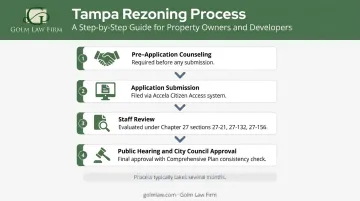
The process can take several months and approval is never guaranteed. Comprehensive-plan consistency is evaluated alongside the zoning request, meaning a rezoning that conflicts with the Future Land Use Map faces a higher barrier.
Variances
A variance allows deviation from specific development standards — a reduced setback, for example — without changing the zoning district itself. Key points:
- Applications are submitted through Accela and governed by Sections 27-76 and 27-80
- Decided by the Variance Review Board at a public hearing
- Approval requires demonstrating undue hardship unique to the property — a self-created hardship does not qualify
- The VRB weighs substantial competent evidence in the official record
Special Exceptions
A special exception permits a non-standard use in a district where it is not listed as a permitted use, provided the applicant shows the use won't adversely impact the surrounding area. This is distinct from a variance: it addresses what is done on a property rather than how it is developed physically.
Working with Legal Counsel
The rezoning and variance process involves legal filings, public hearings, and strategic presentations to city boards. Common procedural errors that can result in denial or costly delays include:
- Missing a public notice requirement
- Submitting incomplete documentation
- Failing to adequately address the Board's legal criteria
Golm Law Firm handles zoning and land use matters as part of its commercial real estate practice. The firm's experience closing hundreds of millions of dollars in Florida commercial transactions means it understands how regulatory approvals intersect with deal structures, timelines, and closing conditions.
Frequently Asked Questions
What is allowed in commercial zoning in Tampa, Florida?
Typical permitted uses in Tampa's commercial districts include retail stores, restaurants, offices, banks, and personal service businesses. Exact permitted uses vary by district (CN, CG, CI, CBD, etc.) and are catalogued in Table 4-1 of Chapter 27 — always verify the specific district before leasing or permitting.
What is C-3 commercial zoning in Tampa, Florida?
"C-3" is a general commercial classification used in many Florida jurisdictions, but it is not a confirmed active designation under Tampa's Land Development Code. Verify the actual zoning classification on Tampa's official zoning maps or consult a land use attorney before relying on informal shorthand.
What is the difference between City of Tampa zoning and Hillsborough County zoning?
The City of Tampa regulates properties within city limits under Chapter 27 of Tampa's Code of Ordinances. Unincorporated Hillsborough County operates under a separate Land Development Code. A Tampa mailing address does not confirm City jurisdiction — check the City's limits map before applying either code to a property.
How do I apply for a zoning variance in Tampa?
Variance applications are submitted online through the City's Accela Citizen Access system and governed by Sections 27-76 and 27-80 of Chapter 27. Applicants must demonstrate undue hardship unique to the property, and the Variance Review Board decides the matter at a public hearing.
What is a special use permit in Tampa commercial zoning?
A special use permit is required for certain uses not automatically permitted in a zoning district — alcohol sales being the most common example. The process involves a public hearing and review by the zoning administrator or Tampa City Council.
What penalties apply for commercial zoning violations in Tampa?
Under Florida Statutes Section 162.09, first violations are capped at $250 per day; repeat violations can reach $500 per day. Irreparable or irreversible violations may trigger a one-time $5,000 fine per violation.