Introduction
Florida operates differently from most states when it comes to commercial real estate contracts. The moment all parties sign a purchase agreement, it becomes legally binding. There is no mandatory post-signing attorney review window, no cooling-off period, no automatic right to renegotiate.
That distinction has real consequences.
For investors, business owners, developers, and landlords buying or selling commercial property in Florida, the implication is straightforward: attorney review must happen before execution, not after. The Florida Bar confirms that the best time to retain a lawyer is before the purchase contract is signed, because once both parties sign, your leverage to negotiate protections drops sharply.
This guide breaks down what attorney review actually involves in a Florida commercial transaction — what gets examined, where deals unravel, and why the timing of legal involvement changes everything.
Key Takeaways
- Florida commercial purchase agreements bind both parties upon full execution — pre-signing attorney review is the only protection
- Calendar-day rules in the Florida Realtors Commercial Contract include weekend and holiday extensions that shift every deal deadline
- Attorney review covers contingencies, title, leases, zoning, entity authority, and environmental risk — not just purchase price
- Real estate agents cannot legally interpret contract obligations or advise on enforceability under Florida law
- The cost of attorney review is modest relative to the financial exposure of an unreviewed commercial contract
What Is Attorney Review in a Florida Commercial Real Estate Purchase Agreement?
Attorney review is the process by which a licensed real estate attorney examines every clause of a commercial purchase agreement to identify legal risk, confirm enforceability, and protect the client's interests. In Florida, this is a proactive step — not a contractually guaranteed window.
How Florida Differs from Other States
New Jersey's N.J.A.C. 11:5-6.2 provides a 3-business-day attorney review period for certain broker-prepared residential contracts. Illinois' Multi-Board Residential Real Estate Contract 8.0 builds in 5 business days for the same purpose. Both are residential forms — neither applies to commercial contracts — but they illustrate that some states include review rights as a built-in default.
Florida does not.
Under the Florida Realtors Commercial Contract, the Effective Date is the date the last party signs or initials and delivers the offer or final counteroffer. From that moment, binding obligations exist. Fla. Stat. 725.01 further requires that contracts for the sale of land be in writing and signed — treating executed agreements as enforceable transaction documents, not informal term sheets.
What Attorney Review Is Not
Attorney review is not a physical inspection, not a title search, and not something a real estate agent or broker performs. It covers a distinct set of functions:
- Physical inspection — evaluating the property's condition is handled by licensed inspectors, not attorneys
- Title search — identifying ownership history and encumbrances is a separate title examination process
- Agent or broker review — real estate licensees cannot provide legal interpretations of contract obligations
Attorney review is specifically about legal interpretation: identifying risk allocation, confirming enforceability, and protecting your position before the contract binds you.
Why Attorney Review Is Critical for Florida Commercial Transactions
Commercial real estate agreements carry significantly more legal and financial complexity than residential contracts. A single purchase agreement may involve existing tenant leases, environmental liability, zoning restrictions, complex financing structures, and entity-level considerations that standard form contracts address only partially — or skip entirely.
The Stakes Are High
Florida's commercial market puts the dollar amounts in sharp relief. CBRE's multifamily data shows 360 sales totaling $3.3 billion in 2023 across Miami-Dade, Broward, and Palm Beach counties, with average deal sizes ranging from $7.9 million to $12.2 million per transaction. At those price points, a single misunderstood clause can mean millions in exposure.
What Happens Without Review
Without attorney review, buyers and sellers face real, concrete risks:
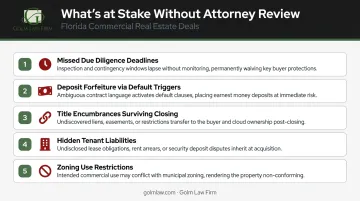
- Due diligence deadlines that close exit windows permanently if missed
- Default provisions that trigger deposit forfeiture or litigation with no warning
- Title encumbrances (easements, liens, restrictive covenants) that survive closing and bind the new owner
- Tenant liabilities — unpaid CAM charges, undisclosed lease defaults — that transfer with the deed
- Zoning restrictions that prohibit the buyer's intended use of the property
"Time Is of the Essence" Has Real Consequences
The Florida Realtors Commercial Contract includes an explicit "time is of the essence" clause. Florida appellate courts treat this language seriously. In Arvilla Motel, Inc. v. Shriver (2004), the court held that a time-is-of-the-essence clause is not boilerplate: the non-defaulting party may cancel immediately after untimely performance.
Missing a contingency deadline by even one day can eliminate a buyer's right to exit or renegotiate. That's why having an attorney track and manage every deadline isn't a luxury — it's what protects the deal.
How Attorney Review Works in a Florida Commercial Transaction
In Florida, attorney review is typically structured around the contract's negotiated due diligence period. That window is the attorney's primary opportunity to surface issues and seek modifications before obligations lock in.
Understanding the Time-Counting Rules
The Florida Realtors Commercial Contract (CC-5xx Rev. 8/24) uses calendar days for periods over 5 days. Periods of 5 days or less exclude Saturdays, Sundays, and national legal holidays. Any deadline falling on a weekend or holiday extends to 5:00 p.m. the next business day.
The updated CC-6 form (March 2025) moved to calendar days for all periods. Identifying which form version governs the transaction is essential before applying any deadline calculation.
Attorney review typically concludes with one of three outcomes:
- Approval with no changes — attorney signs off without modifications
- Recommended amendments or addendums — modifications to address identified concerns
- Identification of a contract-killing issue — triggering a contingency-based exit within the allowed period
Pre-Signing Review
This is the ideal stage. The attorney receives the draft purchase agreement before any party signs, reviews all terms, and provides redlined revisions or a written summary of concerns. No binding obligations exist yet, which means maximum leverage to negotiate. Golm Law Firm offers a 60-minute consultation with document review — including contracts and real estate documents — where clients receive a tailored risk assessment before committing.
Due Diligence Period Oversight
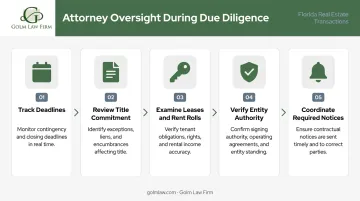
Once the contract is executed, the attorney works alongside inspectors, title agents, and lenders during the negotiated due diligence period. This involves:
- Tracking all contingency deadlines and notice requirements
- Reviewing the title commitment for exceptions and encumbrances
- Examining existing leases, rent rolls, and estoppel certificates
- Verifying entity authority to sell (LLC operating agreements, trust documents, estate authority)
- Coordinating required notices within the prescribed timeframes
Amendments, Closing Coordination, and Final Review
The attorney drafts or reviews amendments to address issues discovered during due diligence, keeping in mind that addendums are legally binding once signed and require the same scrutiny as the original agreement. The attorney also confirms the final settlement statement aligns with contract terms and verifies the seller has proper legal authority to convey title — particularly in transactions involving trusts, LLCs, or estates where authority documentation varies significantly.
What Florida Commercial Real Estate Attorneys Look for in a Purchase Agreement
Purchase Price, Deposits, and Default Provisions
Attorneys examine three interconnected areas before signing off on these terms:
- Whether the deposit is refundable during the due diligence period
- What specifically triggers a default for the buyer versus the seller
- Whether liquidated damages clauses or specific performance remedies are clearly defined
One-sided default provisions appear regularly in commercial contracts and can leave one party with no meaningful remedy if the other walks away.
Due Diligence and Contingency Clauses
Commercial contracts should include a negotiated inspection and due diligence period allowing the buyer to investigate the property's physical, financial, and legal condition. Attorneys verify:
- The period is adequate for the property type and complexity
- Exit rights are clearly stated, not implied
- Cancellation notice requirements are explicit and achievable
- The buyer retains the deposit if the right procedures are followed
Title, Zoning, and Permitted Use
Title commitment review identifies easements, restrictive covenants, and liens that affect commercial use. Separately, attorneys confirm that the property's current zoning and permitted uses align with the buyer's intended purpose. A buyer planning to operate a restaurant in a building zoned for office use will face a costly problem post-closing if that mismatch goes undetected during due diligence.
Existing Leases and Tenant Obligations
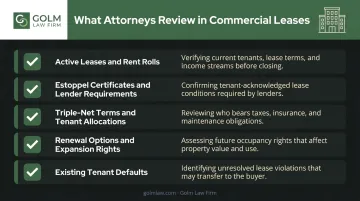
Commercial properties with tenants require thorough lease review. The attorney examines:
- All active leases and current rent rolls
- Estoppel certificates and any lender estoppel requirements
- Triple-net terms and tenant responsibility allocations
- Renewal options, expansion rights, and co-tenancy clauses
- Existing tenant defaults that transfer to the new owner
Lease structures vary significantly across asset classes — a triple-net shopping center and a multi-tenant office building present entirely different risk profiles. Crystal Golm at Golm Law Firm has reviewed these documents across apartment complexes, office buildings, and shopping centers as part of hundreds of millions in closed commercial transactions, where those structural differences directly affect post-closing obligations.
Environmental Considerations
Attorneys flag whether the contract includes environmental contingencies, adequate seller representations about prior property use and hazardous materials, and whether Phase I or Phase II environmental assessments under ASTM E1527-21 are required or already completed. Undisclosed environmental liability doesn't disappear at closing — it transfers to the buyer.
Common Misconceptions About Attorney Review in Florida Commercial Deals
Three misconceptions come up repeatedly in Florida commercial deals — each one worth addressing directly.
"My real estate agent reviewed the contract, so I'm covered."
Real estate agents in Florida are prohibited from interpreting legal obligations or advising on enforceability. Fla. Stat. 454.23 criminalizes unauthorized practice of law, and Keyes Co. v. Dade County Bar Ass'n established that the technical legal steps of transfer belong to lawyers — not brokers.
Agents can help complete business terms in authorized forms, but they cannot interpret contract rights, draft custom legal provisions, or advise whether a party should waive, terminate, or enforce an obligation.
"The due diligence period and attorney review are the same thing."
The due diligence period is a contract provision allowing physical and financial inspection of the property. Attorney review is a legal analysis of the contract itself. Both should happen simultaneously, but they serve different functions.
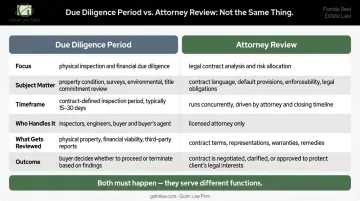
A buyer who completes all physical inspections but never has a lawyer review the default provisions has done half the job.
"I can always fix problems after closing."
Post-closing remedies in commercial real estate are limited, expensive, and heavily dependent on what was specifically represented or disclaimed in the purchase agreement. Issues that could have been resolved during due diligence — title defects, undisclosed leases, zoning non-compliance — become the buyer's problem once the deed transfers.
Frequently Asked Questions
How long is the attorney review period in Florida?
Florida has no statutory attorney review period for commercial contracts. The review window is defined by the due diligence period negotiated in the agreement, which can range from 15 to 60-plus days depending on deal complexity. Unlike New Jersey or Illinois, Florida contracts are binding upon full execution — making pre-signing review the recommended approach.
Is attorney review required for commercial real estate purchases in Florida?
Attorney review is not legally required but is strongly advisable. Florida commercial purchase agreements are binding upon signing with no mandatory review window, so buyers and sellers who skip legal review take on full exposure to unfavorable or misunderstood terms the moment the ink dries.
What does an attorney look for in a Florida commercial purchase agreement?
The primary focus areas are: purchase price and default provisions, due diligence and contingency rights, title exceptions and zoning alignment, existing tenant leases and obligations, and seller representations about the property's condition and legal status. The goal is identifying risk and confirming the contract reflects the client's actual intent.
Can a buyer back out of a commercial real estate contract in Florida?
Exit rights depend entirely on the contract's contingency provisions. If the buyer is within an active inspection or financing contingency period and follows the required notice procedures, cancellation is typically available. Outside those windows, backing out may result in deposit forfeiture or legal liability for breach.
What is the due diligence period in a Florida commercial contract?
It is a negotiated timeframe during which the buyer has the right to investigate the property's physical condition, financials, existing leases, title, and legal compliance. The Florida Realtors Commercial Contract leaves this period blank for the parties to fill in, which makes attorney involvement in negotiating its length and scope especially important.
How much does attorney review cost for a Florida commercial real estate deal?
Fees vary based on deal complexity, property type, and scope of review. Golm Law Firm offers flat-rate buyer/seller representation at $1,500, consultations starting at $150 (30 minutes) or $350 (60 minutes with document review), and hourly arrangements at $475/hour for more complex matters.