This guide covers everything that matters for 2026: Florida's statewide rent control ban, how much a landlord can legally raise rent, required notice timelines by lease type, what makes an increase unlawful, and what tenants can do when they believe a landlord has crossed a legal line.
Key Takeaways
- Florida has no statewide rent control and no cap on how much rent can increase
- Landlords cannot raise rent mid-lease unless the lease explicitly allows it
- All rent increase notices must be in writing — oral notice is unenforceable
- Notice periods range from 7 to 60 days depending on lease type
- State and federal law prohibit retaliatory and discriminatory rent increases
- Miami-Dade County and Palm Beach County impose stricter local notice requirements
Florida Rent Control Laws in 2026: What the State Says
Florida has prohibited local rent control since 1977, when the legislature enacted ch. 77-50, Laws of Florida. Under current F.S. 125.0103 and F.S. 166.043, no county, municipality, or other local government may adopt or maintain any ordinance, rule, or measure that imposes controls on residential rents. Florida is one of 33 states with such a preemption law (meaning state law overrides any local authority to cap rents).
Every recent attempt to change this has failed:
| Bill | Year | Proposal | Outcome |
|---|---|---|---|
| HB 6017 | 2022 | Rent control measures | Not enacted |
| SB 580 | 2022 | Annual rent cap (~10%) | Not enacted |
| HB 365 | 2025 | Limits for affordable units only | Not enacted |
| CS/SB 382 | 2025 | Affordable unit rent definitions | Died in committee |
| HB 811 | 2026 | Rental agreement amendments | No rent cap enacted |
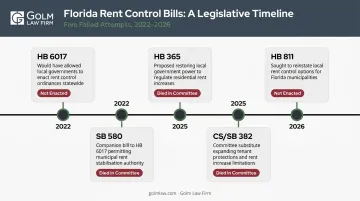
That pattern reflects where Florida's political environment stands heading into 2026: no verified enacted legislation creates a general rent cap on private residential housing.
One point worth clarifying: the 2022 version of Florida law allowed municipalities to adopt temporary rent controls during a "grave housing emergency," limited to 12 months. The current 2025 statutes no longer contain that exception. The 12-month emergency framework is historical — it carries no authority in 2026.
Cities With Local Notice Rules
While local price caps are preempted, two jurisdictions have enacted enhanced notice requirements that landlords must follow:
- Miami-Dade County (Ordinance O-22-30): Requires 60 days' written notice for any residential rent increase above 5%, regardless of lease type
- Palm Beach County (Ordinance 14-81): Also requires 60 days' written notice for increases of 5% or more, applicable to lease terminations and non-renewals as well
These are procedural requirements, not price controls. A landlord in Miami-Dade can still raise rent by 20%, as long as they give 60 days' notice when the increase exceeds 5%. Always check your county or municipal code directly, since local rules can change.
How Much Can a Landlord Raise Rent in Florida?
There is no statutory ceiling on rent increases in Florida. A landlord can legally raise rent by 5%, 50%, or more — as long as proper written notice is given and the increase does not take effect during a fixed-term lease.
The practical constraint is market reality, not law. According to the NAA, a single lease non-renewal costs multifamily landlords approximately $4,000 in turnover expenses. That makes excessive increases a losing trade when reliable tenants walk.
For context, national apartment rent growth was running at roughly 0.4%–0.5% annually as of early 2026, according to CoStar/Apartments.com data. That's a significant cooldown from the 2021–2022 surge. Florida markets like Tampa were showing year-over-year rent decreases in early 2026, meaning most Florida landlords face genuine competition when pricing renewals.
Beyond market conditions, a few legal rules govern when and how often increases can happen:
- No legal limit on how often rent can be raised
- For fixed-term leases, increases can only take effect at renewal (unless the lease contains an escalation clause)
- For month-to-month tenants, increases can occur more frequently — but each requires fresh written notice
- During a declared state of emergency, F.S. 501.160 prohibits "unconscionable prices" for rental housing — this price-gouging statute applies even where ordinary rent control is banned
If a state of emergency is active in your area, consult an attorney before raising rent. The price-gouging rules carry real legal risk even for landlords operating in good faith.
Florida Rent Increase Notice Requirements
Oral notice of a rent increase is not enforceable in Florida. Every increase must be delivered in writing using a valid statutory method: mailing, hand delivery, email (if F.S. 83.505 procedures are followed), or leaving a copy at the residence if the tenant is absent.
Notice Periods by Lease Type
Under F.S. 83.57, the required notice periods are:
| Lease Type | Required Notice |
|---|---|
| Week-to-week | 7 days before end of weekly period |
| Month-to-month | 30 days before end of monthly period |
| Quarter-to-quarter | 30 days before end of quarterly period |
| Year-to-year | 60 days before end of annual period |
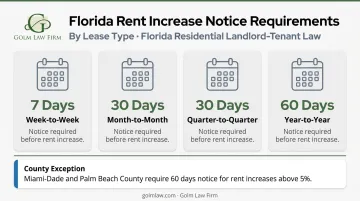
Important correction for 2026: Many older resources cite 15 days for month-to-month tenancies. Current F.S. 83.57 specifies 30 days. Use 30 days as the standard.
If the landlord fails to provide adequate written notice, the tenant is not obligated to pay the increased amount until valid written notice is received and the full notice period has elapsed. The increase is not void — it is simply delayed.
What a Valid Notice Must Include
A legally sound rent increase notice should contain:
- Tenant name(s) and rental property address
- Landlord or property manager name and contact information
- Date the notice is written
- Current rent amount
- New rent amount
- Effective date of the increase
- Reference to the relevant lease clause
Landlords should also include a deadline for the tenant to indicate whether they will renew. This prevents ambiguity and strengthens the landlord's position if a dispute arises.
For landlords who want to get ahead of these requirements, lease language matters. Golm Law Firm offers residential lease drafting at a flat rate of $750; a lease with proper escalation clauses eliminates much of the procedural uncertainty described here. A 60-minute consultation with document review ($350) is also available for landlords who want to verify an existing lease or notice is compliant before sending it.
Valid and Invalid Reasons to Raise Rent in Florida
What Landlords Can Do
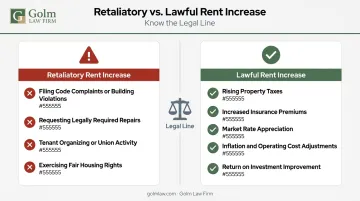
Florida landlords may raise rent for virtually any business reason. Rising property taxes, increased insurance premiums, market appreciation, inflation, or a simple desire to improve return on investment are all valid justifications. None require documentation or disclosure. As long as proper written notice is given and the increase does not violate a fixed-term lease, the increase is legally permissible.
That said, two categories of rent increases are prohibited regardless of the amount or timing.
Retaliatory Increases
Under F.S. 83.64, a landlord cannot raise rent in response to a tenant exercising a protected legal right. Protected activities include:
- Filing a good-faith complaint with a government agency about building or health code violations
- Requesting legally required repairs
- Organizing with other tenants
- Exercising rights under local, state, or federal fair housing law
If a significant rent increase follows shortly after one of these protected activities, a court may treat that timing as evidence of retaliation and shift the burden to the landlord to demonstrate a legitimate business reason. Tenants may raise retaliatory conduct as a defense in any eviction proceeding.
Discriminatory Increases
Under the Federal Fair Housing Act, landlords cannot raise rent selectively based on race, color, religion, national origin, sex, familial status, or disability. Florida's F.S. 760.23 mirrors these protections.
Selective application matters as much as the amount. A landlord who raises rent for one tenant in a protected class while holding other tenants' rates steady can face a Fair Housing complaint or civil liability — even if the dollar amount of the increase is modest.
Landlords who want to confirm their rent increase process holds up to legal scrutiny can schedule a consultation with Golm Law Firm to review their documentation and notice procedures.
What Tenants Can Do When Facing a Rent Increase
Negotiate First
Before taking any legal action, raise the issue directly with the landlord. Tenants with a strong payment record, a long tenancy, and market knowledge have real leverage. Remind the landlord what turnover actually costs — finding a new tenant, lost rent during vacancy, and onboarding expenses often total more than any modest compromise on the increase amount.
Check Procedural Compliance
Verify three things before paying the increased amount:
- Was the notice in writing?
- Was it delivered using a valid statutory method?
- Was it given within the required timeframe for your lease type?
If any of these fail, the increase is not enforceable until properly re-noticed. The tenant does not owe the higher amount until the clock restarts from a valid notice.
Pursue Legal Remedies for Unlawful Increases
If the increase appears retaliatory or discriminatory:
- Document the timeline — record the date of any repair request, complaint, or protected activity, then compare it to the date of the increase notice
- Raise it as a defense — if the landlord proceeds to eviction for non-payment, retaliation and discrimination are valid legal defenses under Florida law
- File an administrative complaint — the Florida Commission on Human Relations handles fair housing complaints under F.S. 760.34, and HUD accepts federal fair housing complaints
- Consult a Florida landlord-tenant attorney to assess whether the increase is legally vulnerable and what remedies are available
Golm Law Firm represents both landlords and tenants in Florida landlord-tenant disputes, including pre-litigation resolution starting at $550 and litigation at $475/hour. A 30-minute consultation ($150) is often enough to determine whether a particular increase is legally vulnerable and what options are realistically available.
Frequently Asked Questions
Can my landlord raise my rent in Florida?
Yes. Florida landlords can raise rent by any amount at the end of a fixed-term lease or with proper written notice for month-to-month tenants. There is no statewide cap on rent increases.
Can a landlord raise rent without notice in Florida?
No. Written notice is required before any rent increase takes effect. Notice periods vary by lease type (see below), and verbal notice doesn't count.
What is the 30% rent rule?
The 30% rule is a personal finance guideline — not Florida law — suggesting tenants spend no more than 30% of gross monthly income on housing. HUD uses a similar threshold to measure rent burden, but it creates no legal protection against rent increases.
How much notice does a landlord need to give before raising rent in Florida?
Notice requirements under F.S. 83.57: 7 days for week-to-week, 30 days for month-to-month, 30 days for quarter-to-quarter, and 60 days for year-to-year tenancies. Miami-Dade and Palm Beach County require 60 days for increases above 5%.
Can a landlord raise rent during a fixed-term lease in Florida?
Generally no. Rent is locked in for the duration of a fixed-term lease unless the lease contains a clause explicitly permitting mid-term increases. Without such a clause, any increase can only take effect at renewal.
What can a tenant do if they believe a rent increase is retaliatory?
Document the timeline between any protected activity (such as a repair complaint or code violation report) and the rent increase notice. Then consult a Florida real estate attorney to assess whether the circumstances support a retaliation defense and what remedies are available.