The short answer: a Florida attorney generally cannot collect a real estate commission for brokerage services unless they also hold an active real estate license issued by the Florida Department of Business and Professional Regulation (DBPR). Florida Bar membership alone doesn't change that.
This article covers what Florida's licensing law actually says, where the attorney exemption begins and ends, when dual licensure is an option, and what legal services an attorney can legitimately provide — and charge for — without ever touching a commission.
Key Takeaways
- Florida's Chapter 475 requires an active real estate license to collect commission for brokerage activities — a Florida Bar license does not substitute
- Attorneys can charge legal fees for contract drafting, title review, and closing oversight without a broker's license
- The §475.011 attorney exemption covers legal duties only — not marketing, showing properties, or negotiating sales for compensation
- Dual-licensed attorney-brokers must disclose both roles in writing and get client consent under Florida Bar Rule 4-1.8(a)
- Unlicensed commission claims are unenforceable in Florida courts and can trigger DBPR sanctions and Florida Bar discipline
What Florida Law Says About Real Estate Licensing
Chapter 475 and Who It Covers
Florida's Chapter 475, Part I — the Real Estate Professional Practice Act — governs who must hold a license to perform real estate brokerage activities. The Florida Real Estate Commission (FREC) administers and enforces it.
Florida Statute §475.01(1)(a) defines a "broker" broadly. Covered acts include:
- Selling, exchanging, buying, or renting real property for another person for compensation
- Advertising or holding out as engaged in those activities
- Taking part in procuring sellers, purchasers, lessors, or lessees
- Assisting in negotiating or closing transactions
Critically, §475.01(3) establishes a single-act rule: performing even one of these acts for compensation is enough to trigger Chapter 475's licensing requirement. There's no threshold of frequency or volume.
The Attorney Exemption — and Its Limits
Florida Statute §475.011(1) does exempt attorneys — but narrowly. The statute exempts a person acting "as an attorney at law within the scope of her or his duties as such."
That limiting phrase is what defines the exemption's boundaries. It protects attorneys who:
- Draft or review purchase and sale agreements
- Advise clients on contractual obligations
- Oversee closings in a legal counsel capacity
- Examine and clear title issues
It does not protect attorneys who:
- Market or advertise a property for sale
- Show homes to prospective buyers
- Solicit sellers or purchasers
- Collect compensation tied to a transaction's successful completion
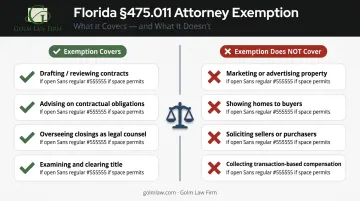
The moment an attorney's activity crosses from legal services into brokerage activity, the exemption ends — and a license is required. Florida Bar membership and DBPR real estate licensing operate as entirely separate regulatory systems — and both apply at once, regardless of professional credentials.
Can an Attorney Collect a Real Estate Commission in Florida?
The direct answer: generally, no.
Under Florida Statute §475.42(1)(a), a person may not operate as a broker or sales associate without a valid, current, active license. And §475.41 makes the consequences clear:
"No contract for a commission or compensation for any act or service enumerated in s. 475.01(3) is valid unless the broker or sales associate has complied with this chapter in regard to issuance and renewal of the license at the time the act or service was performed."
Translation: an unlicensed commission agreement is void. The claim can't be enforced in court.
How Attorney Fees Differ from Real Estate Commissions
These two types of compensation are treated very differently under Florida law:
| Attorney Fee | Real Estate Commission | |
|---|---|---|
| What it pays for | Legal services (drafting, title review, legal advice) | Brokerage activity (marketing, negotiating, facilitating a sale) |
| License required? | No (Florida Bar license only) | Yes — active DBPR broker or sales associate license |
| Tied to transaction outcome? | No | Typically yes |
| Enforceable without license? | Yes | No |
Attorneys who act as brokers without a license often blur this line — and it's precisely where commission claims get voided in court.
What Case Law Shows
Florida courts have consistently voided unlicensed commission claims:
- Schickedanz Bros.-Riviera Ltd. v. Harris, 996 So. 2d 884 (Fla. 4th DCA 2008) — commission award reversed because the claimant acted as a broker without a license
- Bockar v. Sakolsky, 592 So. 2d 251 (Fla. 3d DCA 1991) — summary judgment affirmed against an unlicensed leasing agent seeking compensation
- Cooper v. Paris, 413 So. 2d 772 (Fla. 1st DCA 1982) — commission arrangement involving unlicensed brokerage declared void; commissions already paid were recoverable
The pattern is consistent: Florida courts don't soften the licensing requirement based on the claimant's professional credentials.
The One Lawful Path
Those court decisions define what's prohibited — but the law does carve out one valid path. An attorney who also holds an active Florida real estate broker's or sales associate's license can collect a commission, provided they meet all three of the following conditions:
- Operate through a licensed brokerage — the attorney must be affiliated with and acting under a properly licensed real estate brokerage, not independently
- Comply with all DBPR rules — every regulatory requirement that applies to licensed sales associates and brokers applies equally here, regardless of Bar membership
- Make full written disclosures — both Chapter 475 and Florida Bar ethics rules require written disclosure of the dual role to all parties in the transaction
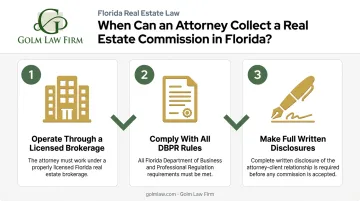
When an Attorney Also Holds a Real Estate License
Florida permits attorneys to hold a real estate license alongside their law license. Florida Bar Opinion 79-4 confirms that a lawyer may maintain a real estate broker's license while also practicing real estate law.
That dual-role arrangement is lawful, but both the Florida Bar and the DBPR impose compliance obligations that govern how it works in practice.
Disclosure Requirements
Under Florida Bar Rule 4-1.8(a), an attorney acting in both capacities in the same transaction must:
- Disclose both roles in writing before the transaction begins
- Ensure the terms of any financial arrangement are fair and fully explained in writing
- Advise the client in writing of their right to seek independent legal counsel
- Obtain the client's informed, written consent to the arrangement
Rule 4-1.7 adds a conflict-of-interest layer: if the attorney's personal financial interest in earning a commission would materially limit their ability to give independent legal advice, they must either decline the commission role or withdraw from legal representation.
Verifying Dual Licensure
Anyone considering a commission arrangement with an attorney should verify their current license status through the DBPR License Search portal. An attorney without an active DBPR listing cannot lawfully collect a commission.
What a Florida Real Estate Attorney Can Do Without a Broker's License
Hiring an attorney for real estate legal services — distinct from brokerage — provides a layer of protection that a broker simply cannot offer. Here's what falls within an attorney's scope without any broker's license:
- Draft and review purchase and sale agreements, including riders, contingencies, and addenda
- Negotiate contract terms on a client's behalf as legal counsel
- Examine title and clear clouds, liens, or defects before closing
- Oversee the closing in a legal counsel capacity
- Advise on zoning and regulatory compliance
- Resolve easements, boundary disputes, and encroachments
All of these services are billed as attorney fees, not commissions. None of them require a DBPR real estate license.
The distinction matters in practice. A broker is trained to facilitate transactions; an attorney is trained to identify legal risk, explain statutory rights, and provide legally privileged advice — a meaningfully different function with different protections for the client.
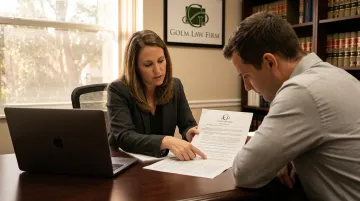
Golm Law Firm handles all of these services across residential and commercial real estate transactions in Florida. The firm offers flat-rate pricing — $1,500 for buyer or seller representation, $1200 for FSBO contract packages, and $950 for commercial lease drafting — with no commission tied to whether the deal closes.
Crystal D. Golm, Esq. has facilitated thousands of residential closings and closed hundreds of millions of dollars in commercial transactions across Manatee County and beyond, working directly with buyers, sellers, investors, developers, and lenders.
Frequently Asked Questions
Can a lawyer be a real estate agent in Florida?
Yes. A Florida attorney can hold a real estate sales associate or broker's license from DBPR simultaneously with their law license. They must obtain it through the standard licensing process, operate through a licensed brokerage, and provide written disclosure to clients when acting in both roles within the same transaction.
What is the new law for realtor commissions in Florida?
Florida has no statutory commission rate — fees are fully negotiable. The biggest recent change came from the August 2024 NAR settlement, which eliminated buyer-agent compensation offers on MLS listings. Buyers must now sign written representation agreements with their agents before touring homes.
How much does a real estate agent make off a $300,000 house?
On a $300,000 sale, a total commission of 5%–6% equals $15,000–$18,000, typically split between the listing and buyer's brokerages. Each side generally nets roughly $7,500–$9,000 before their internal brokerage split. Exact amounts depend on the negotiated rate and agreement terms.
What can a Florida real estate attorney do without a broker's license?
An attorney can draft and review contracts, conduct title research, resolve title defects, advise on legal risks, and oversee closings — all billed as legal fees. None of these services require a real estate license, provided the work stays within legal representation rather than brokerage activity.
What is the difference between an attorney fee and a real estate commission in Florida?
An attorney fee compensates for legal services (contract drafting, title review, legal advice) and is not tied to whether the transaction closes. A real estate commission compensates for brokerage activity such as marketing, negotiating, and facilitating a sale, and requires an active DBPR real estate license to collect lawfully.
Can a seller refuse to pay a real estate commission in Florida?
Under §475.42(1)(d), a sales associate or broker associate cannot personally sue the seller for unpaid commission — only the registered broker can bring that action. Commission amounts are fully negotiable, and the terms of the listing agreement govern what is owed.