Introduction
Florida homeowners have a powerful option most people never hear about until they need it: the Lady Bird deed, formally called an Enhanced Life Estate Deed. It lets you pass your home directly to your chosen beneficiaries at death — without probate, without a court case, and without surrendering control of the property while you're alive.
Florida is one of only a handful of states that recognize this instrument, making it especially valuable for homeowners here. Under Florida Bar authority, the deed is valid and supported by Florida title standards, giving it a solid legal foundation despite having no dedicated statute.
What follows is a practical breakdown of how this deed works, when it makes sense, and where it falls short — so you can decide whether it belongs in your estate plan.
Key Takeaways
- A properly drafted and recorded Lady Bird deed passes your home outside of probate — beneficiaries record a death certificate, nothing more
- You keep full control: sell, refinance, revoke, or change beneficiaries at any time without their consent
- The deed does not trigger Medicaid's five-year lookback penalty because it's not treated as a completed transfer
- Beneficiaries receive a stepped-up tax basis at your death, typically eliminating capital gains if they sell promptly
- Three drafting errors (wrong legal description, missing spousal joinder, no survivorship language) only surface after you die — when nothing can be fixed
What Is a Florida Lady Bird Deed and How Does It Work?
A Lady Bird deed splits ownership into two parts: an enhanced life estate you hold during your lifetime, and a remainder interest that activates only at your death. The remainder passes to your named beneficiaries automatically — no probate case, no court order required.
The "Enhanced" Distinction
The word enhanced is what separates this from a standard life estate. A standard life estate transfers a present interest to the remainder beneficiaries immediately, locking you into shared ownership. An enhanced life estate includes a reserve-powers clause — language in the deed that explicitly preserves your right to:
- Sell or transfer the property
- Mortgage or refinance
- Lease to tenants
- Change or remove remainder beneficiaries
- Revoke the deed entirely
All of this without asking any beneficiary for permission. That single clause is the reason the Lady Bird deed works for Medicaid planning and tax purposes, as explained below.
No Statutory TOD Deed in Florida
Florida does not have a statutory transfer-on-death deed law for real property, making the Lady Bird deed the primary non-probate real estate transfer tool available. Its validity rests on Florida common law, and it is backed by Florida Uniform Title Standards 6.10 and 6.11 — the RPPTL Section's official guidance on enhanced life estates in non-homestead and homestead property respectively.
What Happens at Death
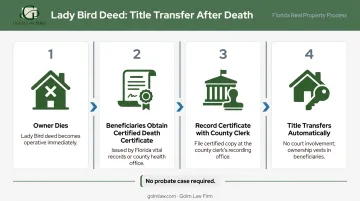
The process involves four steps:
- Owner dies
- Beneficiaries obtain a certified copy of the death certificate
- They record it with the county clerk where the property is located
- Title transfers — no probate case, no new deed needed
"Lady Bird deed," "enhanced life estate deed," and occasionally "Lady Bird trust" all refer to the same Florida instrument. There is no separate Lady Bird trust or Lady Bird will under Florida law.
The deed covers only the specific property described in it and does not replace a full estate plan for other assets.
Key Benefits of a Florida Lady Bird Deed
Probate Avoidance
Property titled through a properly drafted Lady Bird deed passes entirely outside the probate estate. That distinction matters financially. Under Florida Statute 733.6171, presumed-reasonable attorney fees for estate administration start at $1,500 for estates under $40,000 and climb to $3,000 plus 3% of value over $100,000 for mid-size estates. On a $400,000 home, that's $12,000 in attorney fees alone, not counting court filing fees.
By contrast, recording a death certificate with the Manatee County Clerk costs $10.00 for the first page and $8.50 for each additional page. The Florida Bar estimates a simple probate estate takes five to six months to close; the death certificate recording takes days.
Full Owner Control
The grantor keeps every ownership right during life. You can sell, refinance, lease, or revoke the deed without notifying your beneficiaries. Compare that to an outright gift, which permanently surrenders ownership, triggers the carryover basis rules for capital gains, and can create Medicaid lookback problems. That flexibility makes the Lady Bird deed particularly useful for owners who want to keep their options open while still planning ahead.
Medicaid Estate Recovery Protection
Florida's Medicaid Estate Recovery Program (MERP) operates through the probate process — AHCA files a statement of claim against the deceased recipient's probate estate under Florida Statute 409.9101. Property that passes outside probate through a Lady Bird deed falls outside that reach.
Two Medicaid planning advantages stand out:
- No transfer recognized: Florida DCF Medicaid policy explicitly states that retaining a Lady Bird deed means no transfer has occurred, because the grantor retains full ownership powers.
- No lookback penalty: Recording the deed does not trigger Medicaid's 60-month lookback — unlike a standard life estate, which does count as a transfer and can delay eligibility.
Stepped-Up Tax Basis and Homestead Protection
Two additional benefits worth understanding:
- Stepped-up basis: Under IRS Publication 551 and IRC Section 1014, beneficiaries inherit the property at its fair market value on the date of death. If they sell shortly after inheriting, capital gains tax is minimal or zero. An outright gift during life, by contrast, passes your original (often much lower) purchase price as the beneficiary's basis.
- Homestead exemption preserved: Because you retain control and continue to occupy the property, the Florida homestead exemption and Save Our Homes assessment cap remain in effect during your lifetime. The deed does not trigger reassessment or strip existing property tax protections.
Florida Lady Bird Deed vs. Traditional Life Estate vs. Living Trust
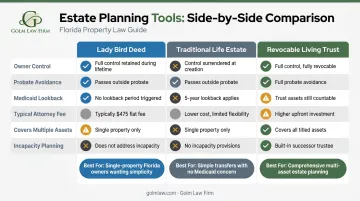
Here's how the three tools compare for a Florida homeowner:
| Feature | Lady Bird Deed | Traditional Life Estate | Revocable Living Trust |
|---|---|---|---|
| Owner control | Full — sell, mortgage, revoke without beneficiary consent | Limited — remainder beneficiaries hold a present interest | Full — trustee manages assets per trust terms |
| Probate avoidance | Yes, for the described property | Depends on deed structure | Yes, for all assets properly funded into trust |
| Medicaid lookback | No transfer — DCF treats as retained ownership | Counts as transfer; remainder value penalized | Not addressed in this scope |
| Typical attorney fee | $475 at Golm Law Firm; market range $400–$1,000 | No reliable benchmark | $1,000–$3,000 simple; $2,000–$5,000+ complex |
| Covers multiple assets | No — one described property only | No | Yes |
| Incapacity planning | No | No | Yes, through trustee succession |
When a Lady Bird Deed Wins
- Single Florida property passing to adult children or a surviving spouse
- Straightforward family situation with no competing interests
- Priority is low cost and minimal complexity
- Medicaid planning is a concern
When a Living Trust Is the Better Choice
- Multiple properties or property in more than one state
- Minor beneficiaries who can't legally hold title
- Blended family dynamics or conditions on inheritance
- Comprehensive incapacity planning is needed alongside probate avoidance
Whichever option fits your situation, keep one limitation in mind: a Lady Bird deed does not replace a will or a full estate plan. It covers only the one property described in it. Bank accounts, vehicles, investment accounts, and other assets still require separate planning.
What Makes a Valid Florida Lady Bird Deed
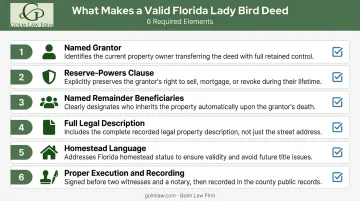
Six elements are required for a deed that will actually work:
- Named grantor who is the current property owner of record
- Reserve-powers clause — language explicitly preserving the right to sell, mortgage, and revoke without remainder consent
- Clearly named remainder beneficiaries
- Full legal description from the prior recorded deed — a street address is not legally sufficient
- Homestead language when the property is the owner's Florida homestead
- Proper execution and recording — signed before two witnesses and a notary, then filed with the county clerk
The Spousal Joinder Requirement
When a married owner wants homestead property to pass to children rather than a spouse, Florida's constitutional homestead protections create an additional layer. The spouse must either join the deed or sign a separate written waiver. Missing this step is one of the most common post-death title failures — title companies will refuse to insure the transfer, and fixing it after death typically requires a quiet-title action.
Survivorship and Contingent Beneficiary Language
The deed should specify what happens if a named beneficiary dies before the owner. Without this language, the deceased beneficiary's share may create a title defect requiring probate of that beneficiary's own estate before clear title can pass. Proper drafting addresses this upfront.
Recording Is Not Optional
A signed but unrecorded Lady Bird deed has no legal effect. Owners sometimes sign the deed at the attorney's office, take it home intending to record it, and never do. At death, the property falls back into probate as if the deed never existed. Golm Law Firm handles drafting, execution, and recording as part of its deed preparation service, eliminating this gap for clients.
Recording costs are straightforward. Manatee County charges $10.00 for the first page and $8.50 per additional page. On documentary stamp tax: under Florida Statute 201.02, the tax is consideration-based — when there is no consideration or mortgage transfer on the Lady Bird deed, no stamp tax on property value should be owed. An attorney can confirm whether any exceptions apply to your specific deed.
Limitations and Common Mistakes to Avoid
A Lady Bird deed works well within its intended scope — but it has real limits. Knowing what it cannot do, and where drafting errors hide, prevents costly surprises down the road.
What the Deed Cannot Do
- No creditor protection during life: Because you retain full ownership, the property remains subject to your judgment liens, tax liens, and creditor claims. Florida homestead protection comes from Article X, Section 4 of the Florida Constitution — not from the deed itself.
- No trust-like features or incapacity management: The deed cannot hold property for a minor, stagger distributions, attach conditions to a transfer, or help manage the property if you become incapacitated. A durable power of attorney or trust is needed for those functions.
Three Drafting Mistakes That Only Surface After Death
These defects are invisible while the owner is alive. By the time they appear, the owner cannot sign a corrected deed:
- Legal description from a tax bill instead of the prior recorded deed — creates a chain-of-title mismatch that title companies reject at closing
- Missing spousal joinder on homestead property — the title company refuses to insure the transfer; resolution requires court action
- No survivorship or contingent-beneficiary language when a beneficiary predeceases the owner — the deceased beneficiary's share requires probate of their own estate before clear title can be established
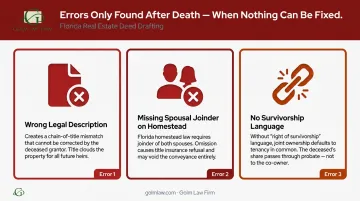
Each of these errors can only be corrected through probate or a quiet-title action — the exact process the deed was designed to avoid.
When a Lady Bird Deed Is (and Isn't) Right for You
The Lady Bird deed works best for a Florida homeowner with a single property, adult beneficiaries, a straightforward family situation, and a goal of low-cost probate avoidance. In that scenario, it delivers real value with minimal complexity.
It's the wrong tool when:
- The family involves a second marriage or blended family dynamics
- A beneficiary is a minor, has creditor problems, or receives government benefits
- The estate includes property in multiple states
- The owner wants conditions or staggered distributions on the inheritance
- Comprehensive incapacity planning is part of the goal
In those situations, a revocable living trust or a combination of planning tools will serve you better.
Golm Law Firm, based in Bradenton and serving clients throughout Manatee County and across Florida, offers consultations to help homeowners work through exactly this analysis: which tool fits their specific family and property situation, and what additional planning — a will, durable power of attorney, or trust — belongs alongside it. A 30-minute consultation starts at $150; a 60-minute consultation with document review is $350.
Frequently Asked Questions
Does an enhanced life estate deed in Florida avoid probate?
Yes. A properly drafted and recorded enhanced life estate (Lady Bird) deed passes the described property outside of probate entirely. Beneficiaries record a certified copy of the death certificate with the county clerk — no probate case is opened for that property.
What is the difference between an enhanced life estate deed and a Lady Bird deed?
There is no substantive difference. "Lady Bird deed" is the informal name; "enhanced life estate deed" is the formal legal term. Both refer to the exact same Florida instrument with the same reserve-powers clause and legal effect.
Does a Lady Bird deed protect my home from Medicaid estate recovery in Florida?
Because Florida's recovery program is probate-based, property passing outside probate through a Lady Bird deed generally avoids recovery. This applies at death, not to the Medicaid qualification process itself. Those are separate planning questions.
Can I sell or refinance my home after signing a Florida Lady Bird deed?
Yes. As long as the deed includes proper reserve-powers language, you retain full rights to sell, mortgage, or refinance during your lifetime without any consent from the remainder beneficiaries.
Can I change the beneficiary on a Florida Lady Bird deed?
Yes. Record a new Lady Bird deed with updated beneficiaries and the prior deed is superseded. No consent from the existing beneficiaries is required.
Do I need an attorney to prepare a Florida Lady Bird deed?
Florida law doesn't require one, but professional drafting is strongly recommended. The three most costly errors (wrong legal description, missing spousal joinder, missing survivorship language) are invisible during your lifetime. Correcting them after death requires probate or a quiet-title action — costs that far exceed professional deed preparation upfront.