
Florida courts are unambiguous: a corporation cannot represent itself. The consequences of getting this wrong range from stricken filings to default judgments entered without any hearing on the merits. This article explains the general rule, the one narrow exception, how the rule applies to LLCs, and what happens when businesses attempt to go it alone.
Key Takeaways
- Florida corporations must be represented by a licensed attorney in Circuit Court and County Court. Officers, CEOs, and sole shareholders cannot substitute for counsel.
- LLCs face the same requirement — a manager or member without a law license cannot file pleadings or appear on the entity's behalf.
- Florida Small Claims Court (disputes under $8,000) is the only recognized exception— and even then, the judge retains discretion over representation.
- Unauthorized filings are treated as if they were never filed, which can trigger procedural default.
- A default judgment can end a case entirely without any hearing on the merits.
The General Rule: Florida Corporations Must Be Represented by an Attorney
Florida courts have applied this rule consistently for decades. A corporation is not a natural person — it cannot walk into a courtroom and speak for itself. Without a licensed attorney, it has no legal voice.
What the Case Law Establishes
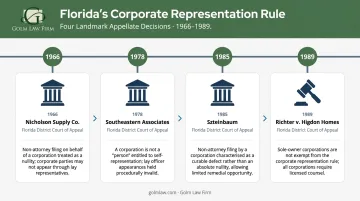
Four Florida appellate decisions form the core of this rule:
- Nicholson Supply Co. v. First Federal Savings & Loan Ass'n of Hardee County, 184 So.2d 438 (Fla. 2d DCA 1966) — a complaint signed by a non-attorney corporate officer was treated as a nullity.
- Southeastern Associates, Inc. v. First Georgia Bank, 362 So.2d 967 (Fla. 1st DCA 1978) — a corporation is not a "person" entitled to conduct its own defense under Fla. Stat. § 454.18; even a sole stockholder cannot appear on the corporation's behalf.
- Richter v. Higdon Homes, Inc., 544 So.2d 300 (Fla. 1st DCA 1989) — a sole-owner corporation is not exempt from this requirement.
- Szteinbaum v. Kaes Inversiones y Valores, 476 So.2d 247 (Fla. 3d DCA 1985) — reaffirmed the rule while treating a non-attorney filing as a curable defect in appropriate circumstances, rather than requiring automatic dismissal in every case.
The rule is consistent across all three District Courts of Appeal. No Florida court has carved out an exception for small companies, closely-held corporations, or owner-operators.
Which Courts This Covers
Florida's trial courts divide jurisdiction by dollar amount:
- County Court handles civil actions at law up to $50,000 (for cases filed on or after January 1, 2023, per Fla. Stat. § 34.01)
- Circuit Court handles actions exceeding county court jurisdiction under Fla. Stat. § 26.012
The attorney representation requirement applies in both. That covers the overwhelming majority of business disputes.
The Rule Applies Whether You're Suing or Being Sued
It does not matter whether the corporation initiates the lawsuit or is defending one. A corporation that ignores this when defending a contract claim faces the same procedural risks as one that files without counsel.
Attorney representation is also not the only box to check. Florida Statute § 607.0501(6) adds a separate threshold condition: a corporation cannot prosecute or maintain a Florida court action unless it maintains a registered agent and complies with the applicable statutory requirements under Chapter 607. Meeting that baseline is a prerequisite — licensed counsel is then required on top of it.
Why This Rule Exists: The Legal Foundation
A corporation exists as a separate legal entity — distinct from its owners, officers, and employees. That separation is what gives a corporation its most valuable attributes: limited liability, perpetual existence, transferable ownership. But it also means the corporation cannot act without a representative who is authorized to practice law.
When a non-attorney appears on behalf of a corporation, that person is not representing themselves. They are representing a separate legal entity — and that is the practice of law.
The Unauthorized Practice of Law Problem
This is not merely a procedural technicality. Florida Statute § 454.23 makes practicing law without a Florida Supreme Court license a third-degree felony. Rule Regulating the Florida Bar 10-2.1 defines unlicensed practice by reference to Florida statute, court rule, and case law.
Courts have consistently struck filings from non-attorney corporate representatives on this basis. Permitting such filings would not be a minor procedural slip — it would constitute unauthorized practice of law.
Federal Courts Apply the Same Standard
Florida's federal courts apply the same standard. Two parallel rules make this explicit:
- M.D. Fla. Local Rule 2.02(b)(2): A party other than a natural person can appear only through a licensed attorney.
- S.D. Fla. Local Rule 4: Contains an identical requirement for entities appearing in federal court.
The M.D. Fla. court has expressly extended this rule to LLCs, citing Energy Lighting Mgmt., LLC v. Kinder, 363 F. Supp. 2d 1331 (M.D. Fla. 2005).
The Exception: Florida Small Claims Court
There is one recognized exception to the attorney requirement. Florida Small Claims Court handles civil disputes where the claim value does not exceed $8,000, exclusive of costs, interest, and attorney's fees.
How the Exception Works
Under current Florida Small Claims Rule 7.050(a)(2) (effective January 1, 2026), a business entity recognized under Florida law may be represented at any stage of trial-court small claims proceedings by:
- A principal with authority to bind the entity, or
- An employee authorized in writing by a principal
The authorization must be documented using Small Claims Form 7.350 — "Authorization to Allow Employee to Represent Business Entity at Any Stage of Lawsuit." The form requires:
- The principal's name and title
- The entity's name and type
- The authorized employee's name
- The case caption and case number
- The principal's signature — which also authorizes the employee to appear at mediation
Important Caveats
This exception has limits:
- It applies only at the trial court level — not on appeal
- The trial judge retains discretion. If the court determines the corporation is in the business of collecting claims — such as a debt buyer or claims assignee — the judge may require attorney representation regardless of the threshold
- A dispute technically under $8,000 that involves contract interpretation, commercial lease terms, or real property issues may still warrant counsel — the dollar amount alone doesn't measure legal complexity
For businesses that regularly pursue or defend small claims, keeping a pre-signed Form 7.350 on file streamlines appearances. Once a claim exceeds $8,000 — or carries meaningful financial or legal exposure — the exception no longer applies, and corporate representation by a licensed attorney becomes mandatory again.
How This Rule Applies to LLCs and Other Business Entities
Florida courts apply the same attorney-representation requirement to LLCs. A manager or member who is not a licensed Florida attorney cannot file pleadings, argue motions, or appear in Circuit or County Court on the LLC's behalf.
The legal reasoning follows the same logic as the corporate rule: an LLC is a separate legal entity, not a natural person. Appearing on its behalf constitutes the practice of law. Courts have struck filings made by non-attorney LLC representatives and applied the same procedural consequences that apply to corporations.
In Florida federal court, Energy Lighting Mgmt., LLC v. Kinder directly established that LLCs must appear through licensed counsel in the Middle District. Later M.D. Fla. orders have cited Energy Lighting for this point, and the current local rules use the broader phrase "party other than a natural person" — covering both corporations and LLCs under a single standard.
That "separate legal entity" logic is precisely what distinguishes LLCs and corporations from sole proprietors. Here is how the requirement breaks down across common business structures:
- Sole proprietors can appear pro se — the individual is the legal party, with no separate entity involved
- LLCs must retain licensed counsel; a manager or member cannot represent the entity in court
- Corporations face the same rule; an officer or shareholder cannot substitute for an attorney
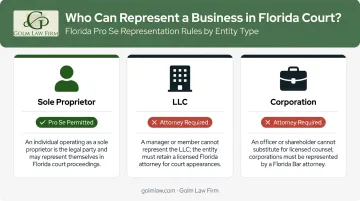
The moment a business owner forms an LLC or corporation, the pro se option disappears for entity-level litigation.
Consequences of Attempting Self-Representation for a Corporation
The practical consequences of a corporation appearing without counsel are serious and can cascade quickly.
Immediate Procedural Consequences
Under Florida Rule of General Practice and Judicial Administration 2.515, a document not signed in compliance with the rule may be stricken, and the action may proceed as though the document was never served. Szteinbaum applied the predecessor to this rule to a non-attorney corporate filing. The practical effect: any motion, answer, or pleading filed by a non-attorney on behalf of a corporation is treated as a nullity.
The Default Judgment Risk
This is where the real damage occurs. If a corporation's answer is stricken because it was filed by a non-attorney, the corporation is now in the same position as if it never responded to the lawsuit. The opposing party can then seek a default under Florida Rule of Civil Procedure 1.500.
A default judgment can result in the corporation losing the case entirely: no hearing on the merits, no opportunity to present defenses.
David Boggs, LLC v. Soltis, No. 6:18-cv-00687 (M.D. Fla.) illustrates exactly this sequence. The LLC's non-attorney answer was stricken for failure to comply with the local counsel rule. A clerk's default followed, and a partial final judgment was eventually entered against the LLC.
The Financial Calculation
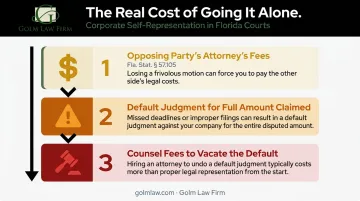
Business owners sometimes attempt self-representation to avoid legal fees. The math rarely works out. A corporation that fails to properly appear may face:
- The opposing party's attorney's fees in certain circumstances under Fla. Stat. § 57.105
- A default judgment for the full amount claimed
- The cost of hiring counsel to attempt to vacate a default — often more expensive than retaining counsel from the outset
Working With a Florida Business Attorney for Corporate Litigation
When selecting Florida counsel for corporate litigation or defense, look for:
- Knowledge of Florida's Business Corporation Act (Chapter 607) and applicable LLC statutes
- Hands-on experience with your dispute type — breach of contract, commercial lease conflicts, creditor/debtor matters, and real estate cases each carry distinct procedural requirements
- Prior experience in the specific court where your case is pending (County Court, Circuit Court, or federal district court)
If your business is based in or operating through Manatee County or the surrounding area, Golm Law Firm, P.A. in Bradenton represents corporations, LLCs, developers, investors, and business owners in business and real estate legal matters. The firm offers litigation representation at $475/hour with retainers starting at $5,000, along with pre-litigation dispute resolution services starting at $550 for limited-scope matters — a practical option for businesses seeking legal guidance before disputes escalate.
Frequently Asked Questions
Does a corporation have to be represented by an attorney in Florida?
Yes. Under well-established Florida law, a corporation cannot represent itself in Circuit Court or County Court and must be represented by a licensed Florida Bar attorney. The only recognized exception is Small Claims Court for disputes under $8,000.
What is Florida Statute § 607.0704?
Florida Statute § 607.0704 governs shareholder action by written consent without a meeting; it is an internal corporate governance statute, not a court-representation rule. A separate provision, § 607.0501(6), bars corporations from prosecuting or maintaining Florida court actions unless they maintain a registered agent and comply with Chapter 607 requirements.
Can an LLC represent itself in Florida courts?
No. LLCs are subject to the same rule as corporations. A manager or member who is not a licensed attorney cannot represent the LLC in Florida Circuit or County Court, and courts will strike filings made by non-attorney LLC representatives.
What happens if a corporation tries to represent itself without a lawyer in Florida?
The court will strike the unauthorized filings, leaving the corporation in procedural default. This can result in a default judgment against the corporation or dismissal of its claims, with no hearing on the merits.
Can a corporation represent itself in Florida small claims court?
Yes, under Florida Small Claims Rule 7.050(a)(2), a corporation may appear through a principal or an employee authorized in writing using Form 7.350. However, the trial judge retains discretion to require counsel if the circumstances warrant it.
Does the attorney representation requirement apply in Florida federal courts?
Yes. The Middle District of Florida's Local Rule 2.02(b)(2) and the Southern District's Local Rule 4 both require corporations and LLCs to appear through licensed counsel admitted to practice in that court. Attorneys not yet admitted to the federal bar must seek pro hac vice admission before appearing.